
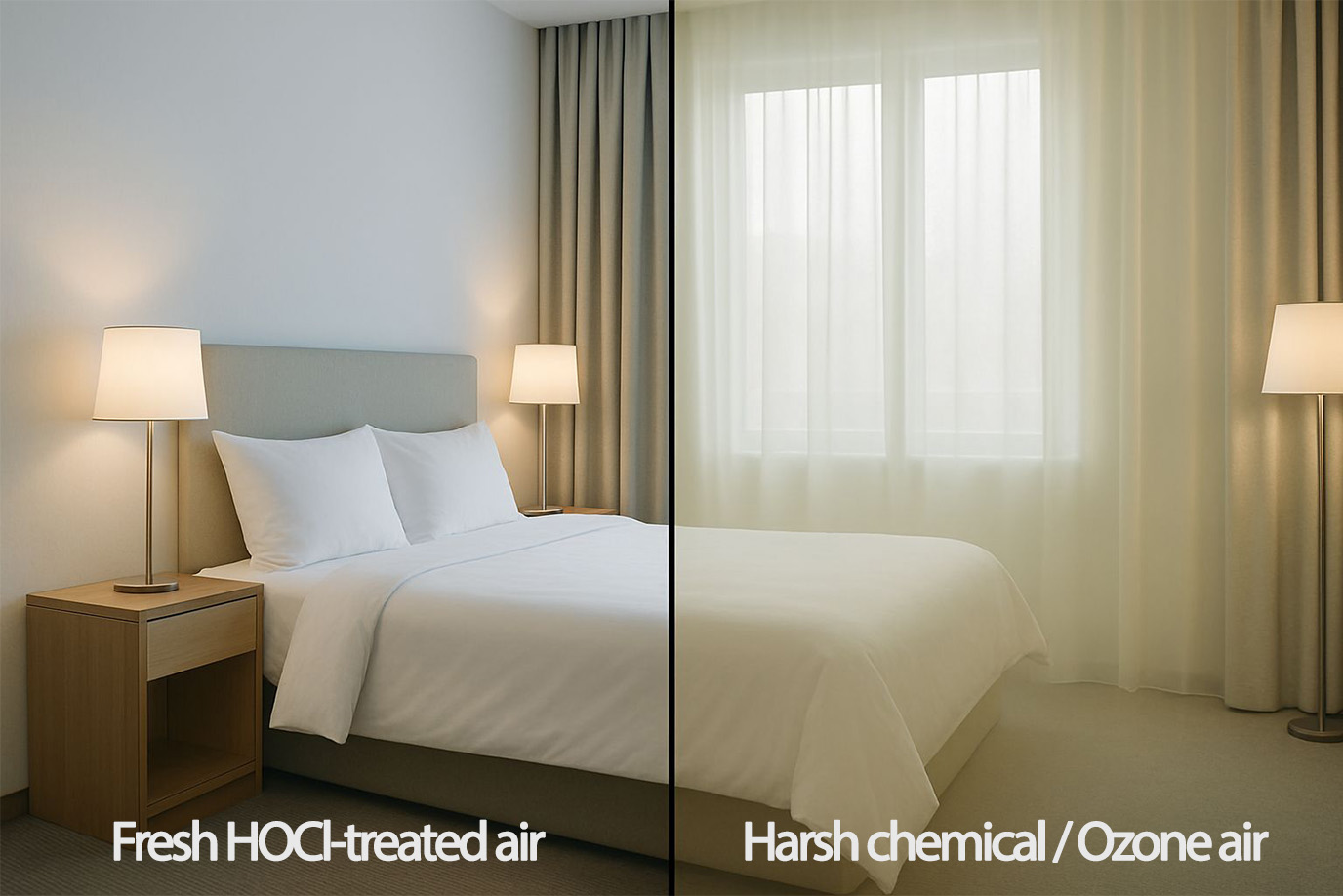
Odor Control Redefined: Why HOCl Outperforms Ozone and Harsh Chemicals
Hypochlorous acid (HOCl) is becoming one of the safest and most effective tools for modern facility odor control.
Facilities relying on ozone generators or harsh chemical deodorants often face corrosion, safety concerns, and recurring odor complaints.
HOCl neutralizes odor at the molecular level without masking smells or damaging people, equipment, or indoor air quality.
The Problems with Traditional Odor Control Methods
Ozone Based Systems
- Health risks: Even low concentrations can irritate eyes, throat, and lungs; OSHA strictly limits exposure.
- Corrosive impact: Damages metals, wiring, elastomers, and HVAC components.
- Secondary pollutants: Reacts with VOCs to form compounds like formaldehyde.
- Unreliable performance: Effectiveness drops in real world environments with airflow, humidity, and dust.
Harsh Chemical Deodorizers
- Strong chemical odors: Often create new complaints instead of solving the problem.
- Material damage: Can degrade plastics, fabrics, stainless steel, and sensitive equipment.
- Environmental concerns: Disposal and runoff are regulated and require PPE.
- Odor masking: Many products cover smells rather than neutralizing them.
The HOCl Advantage
Hypochlorous acid (HOCl) oxidizes odor causing compounds and breaks them down at the source.
It is safe for occupied environments and effective across air, surfaces, and porous materials.
Key Benefits of HOCl for Odor Control
- Safe for occupied spaces: No harmful residues or downtime under normal use parameters.
- Non corrosive: Compatible with metals, fabrics, electronics, and HVAC systems.
- Biodegradable: Breaks down into saltwater after use.
- Rapid action: Neutralizes bacteria, mold, VOCs, and organic odor compounds on contact.
- Flexible application: Fogging, misting, spraying, or HVAC injection.
Concentration Matters
Envirolyte on site HOCl generation allows facilities to adjust concentration based on odor severity while maintaining safety.
- ~50 ppm: Preventative odor control for offices, lobbies, schools, and hotel corridors.
- 100–150 ppm: Moderate odors from moisture, light organics, gyms, and kitchens.
- 200–300+ ppm: Heavy duty odor control for waste rooms, restrooms, animal facilities, and food processing.
How HOCl Integrates into Facilities
Fogging & ULV Application
- Even distribution across air, fabrics, and surfaces.
- Rapid reduction of airborne odor compounds.
- No rinsing required.
HVAC Injection
- Continuous odor control through treated recirculated air.
- Helps prevent microbial growth inside ductwork.
- Fully compatible with HVAC components.
Facility Impact
- Reduces odor complaints across commercial, healthcare, hospitality, and industrial spaces.
- Improves indoor air quality metrics.
- Eliminates reliance on ozone cycles or harsh chemicals.
A Safer, Smarter Approach to Odor Control
Upgrade Your Odor Control Strategy
HOCl gives facilities a powerful, science backed way to eliminate odors without exposing occupants or assets to risk.
Envirolyte USA provides on site HOCl generation, fogging programs, and HVAC integration designed for real world conditions.
