
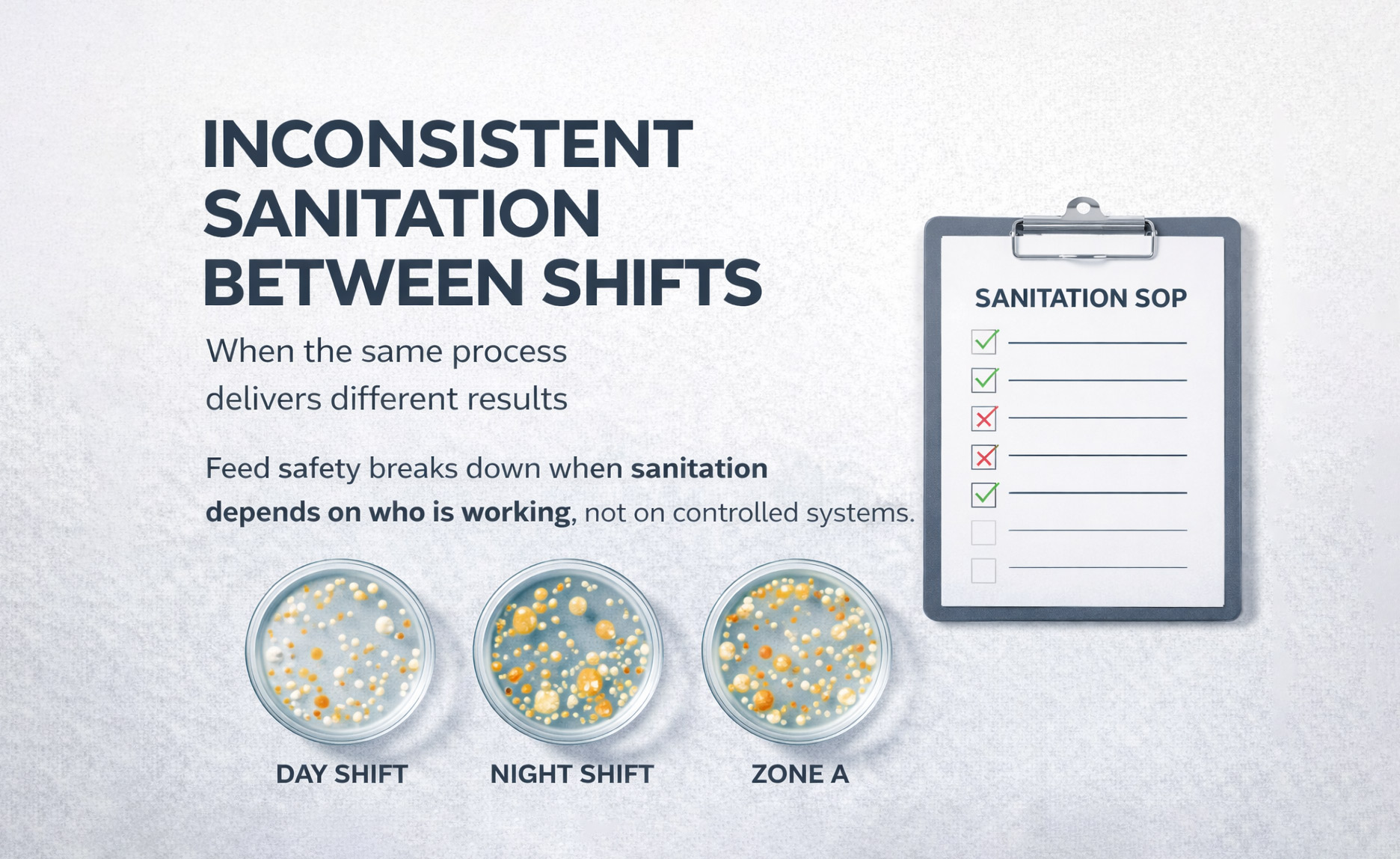
Inconsistent Sanitation Outcomes Between Shifts
Why Variability Undermines Feed Safety, and How Envirolyte USA Restores Control
In animal food ingredient and feed handling facilities, sanitation programs are often well designed on paper, validated chemicals, written SOPs, defined CIP parameters. Yet in practice, sanitation effectiveness frequently varies by operator, by shift, and by location within the same facility.
Across sanitation reviews, root cause analyses, and corrective action discussions conducted in customer feed and ingredient facilities, Envirolyte USA frequently identifies variability as one of the most common underlying drivers of inconsistent microbial results. When microbial results fluctuate despite the same process, the issue is rarely intent or effort. It is almost always process variability driven by chemistry management and application inconsistency.
This article examines why sanitation outcomes differ across shifts, the technical factors behind that variability, and how Envirolyte USA on site electro activation approach produces consistent, measurable sanitation performance.
The Problem: Sanitation That Depends on Who Is Working
Many feed facilities experience sanitation outcomes that differ based on:
- Operator experience and technique
- Shift day vs night sanitation crews
- Specific zones or equipment within the facility
These inconsistencies show up as:
- Sporadic positive environmental swabs
- Repeated corrective actions in the same areas
- Conflicting sanitation records despite identical SOPs
- Increased scrutiny during third party or regulatory audits
From a QA perspective, inconsistency is more damaging than outright failure. It undermines confidence in the entire sanitation system.
Why Inconsistent Outcomes Occur
1. Manual Mixing and Dilution Errors
Many conventional sanitation programs rely on:
- Manual chemical dilution
- Portable foamers or sprayers
- Visual estimation or basic titration checks
Even small deviations in concentration can lead to under or over sanitization, especially when different operators prepare solutions independently. Over time, these small deviations accumulate into meaningful variability in microbial outcomes.
2. Chemical Degradation Over Time
Several commonly used sanitizers degrade after preparation:
- Chlorine based solutions lose available chlorine when exposed to heat, light, organic matter, or storage time.
- Pre mixed solutions prepared at the start of a shift may be significantly weaker by the time they are applied hours later.
This degradation means that two operators following the same SOP may unknowingly apply very different effective concentrations, depending on timing and storage conditions.
3. Inconsistent Application Methods
Sanitation efficacy is not determined by chemistry alone. It is influenced by:
- Spray pressure and coverage
- Foam dwell time
- Contact time variability
- Equipment accessibility and geometry
When application depends heavily on individual technique rather than system control, sanitation outcomes naturally diverge between shifts and crews.
The QA and Audit Impact of Variability
Regulatory and third party audit frameworks emphasize:
- Repeatability
- Verification
- Control
When sanitation outcomes vary:
- Environmental monitoring programs show trends instead of stability
- Corrective actions multiply without addressing root causes
- Auditors question whether sanitation controls are truly validated or merely procedural
From a documentation standpoint, inconsistent sanitation is difficult to defend, even if average results appear acceptable.
How Envirolyte USA Eliminates Shift Based Variability
Envirolyte USA addresses inconsistency by removing the most common sources of variability observed in customer facilities, manual chemistry management and chemical instability.
On Site Electro Activation Equals Consistent Chemistry
Envirolyte USA systems generate electro activated solutions on site, delivering:
- Consistent, measured concentration
- Freshly generated solution at the point of use
- Elimination of storage related degradation
This ensures that every shift, every operator, and every application starts with the same effective chemistry.
Reduced Dependence on Operator Technique
Because Envirolyte USA solutions are:
- Effective at low concentrations
- Stable at neutral to mild pH
- Less sensitive to minor dosing variation
The sanitation outcome becomes less dependent on individual technique and more dependent on controlled system parameters.
Standardization Across Zones and Equipment
Envirolyte USA enables facilities to apply:
- The same sanitation platform across multiple areas
- Consistent application protocols with predictable results
This improves sanitation uniformity between:
- High risk and low risk zones
- Primary and secondary equipment
- Different sanitation crews
Operational Results with Envirolyte USA
Facilities integrating Envirolyte USA commonly report:
- More predictable sanitation performance
- Reduced variability in environmental monitoring results
- Fewer repeat corrective actions
- Improved confidence during internal and external audits
From a QA standpoint, this consistency supports defensible sanitation validation, making it easier to demonstrate control rather than reliance on procedural compliance alone.
Consistency Is the Real Measure of Sanitation Control
Sanitation programs fail not only when microbes survive, but when results cannot be reproduced consistently. In feed and ingredient facilities, variability driven by manual mixing, chemical degradation, and operator technique is a systemic risk to both food safety and audit readiness.
Envirolyte USA enables a shift from operator dependent sanitation to system controlled sanitation, delivering consistent chemistry, predictable outcomes, and stronger QA confidence across every shift.
References
- Cleaning and Sanitizing in Food Processing Operations, University of Florida IFAS Extension https://edis.ifas.ufl.edu/publication/FS077
- Sanitizers for Food Plants, Oregon State University https://seafood.oregonstate.edu/sites/agscid7/files/snic/sanitizers-for-food-plants.pdf
- Hazard Analysis and Risk Based Preventive Controls for Animal Food, FDA https://www.fda.gov/food/animal-food-guidance-documents/hazard-analysis-and-risk-based-preventive-controls-animal-food
- Principles of GMPs for Food and Feed Manufacturing, FAO https://www.fao.org/3/i0488e/i0488e.pdf
- Stability and Degradation of Chlorine Solutions in Food Processing, Journal of Food Protection https://meridian.allenpress.com/jfp/article/78/7/1380/194147
Learn More About Consistent Sanitation Control in Feed Operations
If you are evaluating ways to reduce sanitation variability between shifts while strengthening QA defensibility, our team can share technical information on on site electro activated solution generation and implementation considerations for feed and ingredient facilities.
