
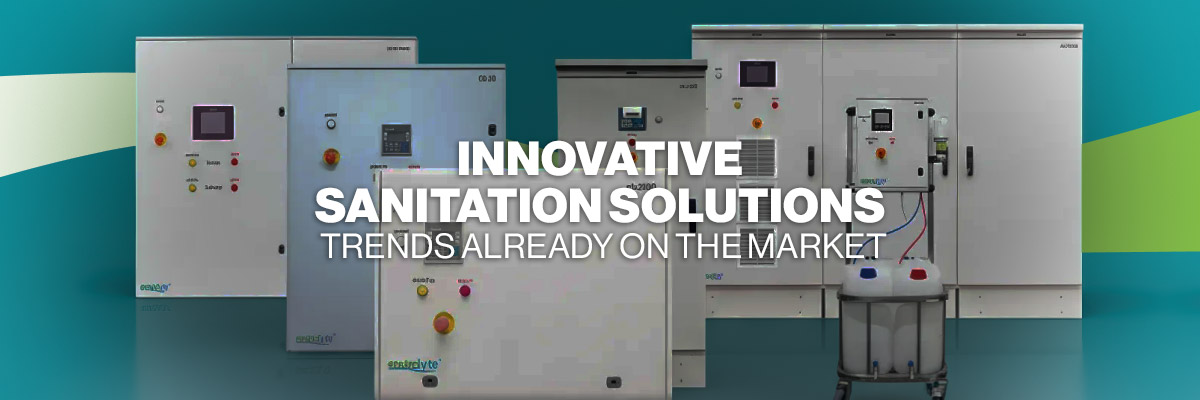
Innovative Sanitation Solutions: Trends Already on the Market
Introduction
Sanitation has evolved significantly in recent years. Among the main innovations is the use of sustainable hygiene technology, which has been replacing conventional chemicals and offering greater efficiency, sustainability, and operational safety.
Today, the market already offers innovative solutions that combine science, technology, and environmental responsibility, redefining the concept of professional cleaning and sanitation.
Below, explore the trends that are already available and how they are revolutionizing different segments.
Electrolyzed Water: Sustainable and Effective Technology
The electrolysis of water and salt results in two distinct solutions: hypochlorous acid (HOCl) and sodium hydroxide (NaOH).
While the first is a natural disinfectant with high microbiological disinfection power, the second acts in the removal of soils, proteins, and fats.
This sustainable technology for industrial sanitation, used by Envirolyte, eliminates the need for aggressive chemicals, reduces residues, and is safe for people and surfaces.
Ozone: Disinfection with High Oxidizing Power
The use of ozone as a disinfecting agent is another consolidated trend.
With strong oxidizing action, it is capable of eliminating viruses, bacteria, and fungi, and can be applied in industrial, hospital, and food environments.
Because it decomposes rapidly into oxygen, ozone is considered a low-environmental-impact alternative.
Ultraviolet Radiation (UV-C): Microbiological Control Without Residues
UV-C technology has been gaining ground as a physical method of disinfection.
Short-frequency radiation damages the DNA of microorganisms, preventing their reproduction.
Applied in air, water, and surface systems, UV-C does not generate chemical residues and is highly effective in areas with strict sanitary control.
Dry Steam: Efficiency in Sensitive Environments
Dry steam is an efficient alternative for cleaning and hygiene in places that require rigorous microbiological control, such as industrial kitchens and hospitals.
With high temperature and low humidity, the method removes soils and eliminates microorganisms without the use of chemicals.
In addition, it is a safe solution for delicate surfaces and electrical equipment.
Intelligence and Automation in Sanitary Control
The advance of digital technology has also reached sanitation.
Sensors, software, and automated systems monitor parameters such as pH, concentration, and solution contact time, ensuring greater precision and traceability. These tools increase the efficiency of hygiene processes and reduce waste.
Conclusion
The hypochlorous acid produced by Envirolyte Brazil is a strategic solution for companies that need safe, efficient, and sustainable disinfection. Its high microbiological efficacy, combined with safety for people, animals, and surfaces, makes HOCl ideal for sensitive sectors such as food, healthcare, and services.
In situ production reduces chemical residues, eliminates the need to store dangerous products, and keeps HOCl always fresh and stable. This improves cost-effectiveness and raises the standard of cleaning and hygiene.
Choosing hypochlorous acid from Envirolyte Brazil means choosing a modern, sustainable solution aligned with today’s requirements for biosafety and operational performance.
Modern sanitation technology should improve control without adding chemical complexity.
If your operation is evaluating safer, more sustainable ways to disinfect sensitive environments, Envirolyte can help you understand where on-site generation of hypochlorous acid fits into your sanitation process and what it could simplify.
