
Worker Safety and Chemical Handling Risks in Feed and Ingredient Facilities
Why Traditional Sanitation Exposes Workers, and How Envirolyte USA Reduces That Risk
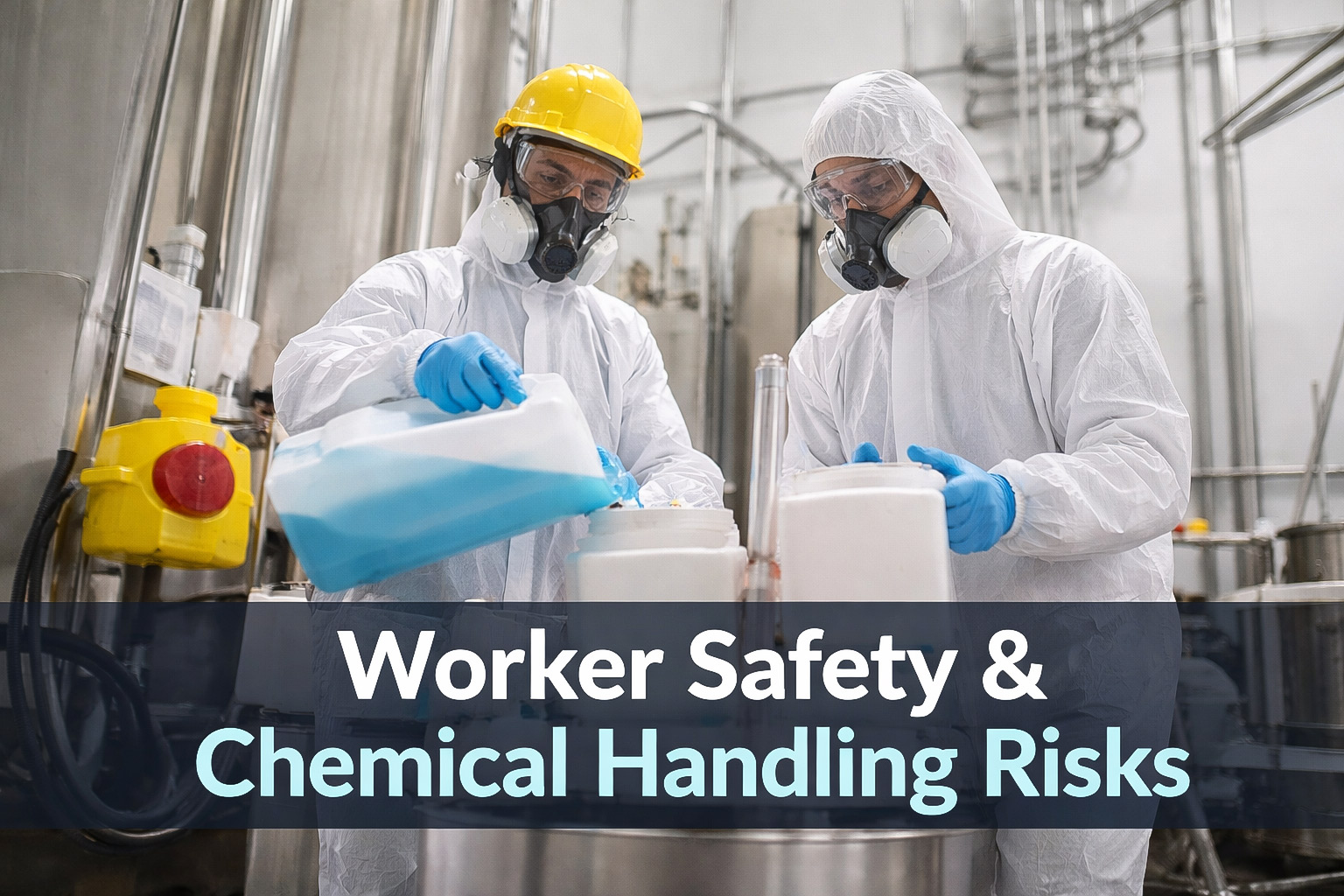
Sanitation programs in animal food ingredient and feed handling facilities are designed to protect product safety. Yet, in many operations, they do so at the expense of worker safety. Strong acids, caustics, and chlorine based oxidizers remain foundational to conventional cleaning and CIP programs, creating daily exposure risks for sanitation crews, maintenance staff, and supervisors.
Across animal food and feed operations, worker safety consistently emerges as a critical, yet often underestimated, driver for sanitation modernization. Chemical handling risks are not isolated incidents; they are systemic outcomes of legacy sanitation architectures that rely on hazardous materials, manual dosing, and extensive personal protective equipment (PPE).
This article examines the real safety risks associated with traditional sanitation chemicals, why those risks persist, and how Envirolyte USA enables safer sanitation practices without compromising microbial control.
The Problem: Routine Exposure to Hazardous Chemicals
Sanitation personnel in feed and ingredient facilities frequently work with:
- Strong caustics (e.g., sodium hydroxide)
- Strong acids (e.g., nitric or phosphoric acid)
- Chlorine based oxidizers (e.g., sodium hypochlorite)
These substances present well documented hazards, including:
- Chemical burns to skin and eyes
- Respiratory irritation from vapors and aerosols
- Heat generation during dilution or reaction
- Risk of toxic gas release when incompatible chemicals are mixed
According to OSHA, exposure to corrosive chemicals is a leading cause of chemical related workplace injuries in industrial settings, particularly during mixing, transfer, and CIP setup operations.
Why Chemical Safety Risks Persist
1. Manual Handling and On Site Storage
Many sanitation programs require:
- Transporting concentrated chemicals
- Manual dilution and mixing
- Storage of incompatible substances in close proximity
Each of these steps introduces opportunities for spills, splashes, incorrect dosing, or accidental chemical reactions.
2. Dependence on PPE Rather Than Hazard Elimination
While PPE is essential, it is fundamentally a last line of defense. In many facilities, worker safety depends on:
- Chemical resistant gloves and aprons
- Face shields and goggles
- Respirators in confined or poorly ventilated spaces
PPE reduces injury severity but does not eliminate the hazard itself. OSHA’s hierarchy of controls clearly prioritizes hazard elimination and substitution over reliance on PPE.
3. Chemical Incompatibility and Fume Risk
Chlorine based products, in particular, pose serious risks when mishandled. Mixing chlorine with acids can release chlorine gas, a highly toxic respiratory irritant. Even low level exposure can cause acute symptoms, while higher concentrations can be life threatening.
These risks are amplified during CIP changeovers, emergency cleaning, or corrective sanitation events, precisely when time pressure and fatigue are highest.
Regulatory and Liability Implications
Worker exposure incidents trigger consequences beyond immediate injury:
- OSHA recordables and inspections
- Increased workers’ compensation claims
- Training and retraining requirements
- Potential citations for improper chemical handling or storage
Chemical safety failures also affect morale and retention in sanitation teams, roles that are already difficult to staff consistently in many regions.
How Envirolyte USA Reduces Worker Safety Risk
Envirolyte USA addresses worker safety not by adding more PPE, but by reducing the inherent hazard of sanitation chemistry itself.
On Site Generation Eliminates Chemical Transport and Mixing
Envirolyte USA systems generate electro activated solutions on site, eliminating:
- Transport of hazardous concentrates
- Manual dilution and mixing
- Storage of large volumes of corrosive chemicals
This significantly reduces the most common points of chemical exposure and injury.
Low Hazard Chemistry at Neutral to Mild pH
Envirolyte USA’s hypochlorous acid based solutions operate at neutral to mild pH and at low concentrations, reducing:
- Skin and eye burn risk
- Fume generation
- Corrosive exposure during application
While still effective against microorganisms, these solutions are inherently safer for routine handling and application.
Reduced Need for Emergency Response Scenarios
Because Envirolyte USA solutions do not rely on aggressive acids, caustics, or high strength oxidizers, facilities reduce the likelihood of:
- Chemical incompatibility incidents
- Chlorine gas release scenarios
- Emergency evacuation or medical response events
Operational Benefits Beyond Safety
Facilities adopting Envirolyte USA often experience secondary gains tied directly to improved worker safety:
- Simplified training for sanitation staff
- Lower incident and near miss rates
- Reduced dependency on heavy PPE
- Improved confidence during audits and inspections
Importantly, these safety improvements are achieved without compromising sanitation efficacy, and often alongside gains in efficiency and consistency.
Safer Sanitation Is a System Design Choice
Worker injuries related to sanitation chemicals are not unavoidable costs of doing business. They are the predictable outcome of chemical heavy sanitation systems designed around hazard management rather than hazard reduction.
Envirolyte USA enables feed and ingredient facilities to shift toward safer sanitation by design, reducing chemical handling risks, improving compliance with OSHA’s hierarchy of controls, and protecting the people responsible for keeping operations clean and compliant.
References & Further Reading
- Occupational Safety and Health Administration (OSHA), Hazard Communication Standard (29 CFR 1910.1200) https://www.osha.gov/laws-regs/regulations/standardnumber/1910/1910.1200
- OSHA, Safety and Health Topics: Corrosive Chemicals https://www.osha.gov/corrosive-chemicals
- National Institute for Occupational Safety and Health (NIOSH), Chlorine: Immediately Dangerous to Life or Health (IDLH) Documentation https://www.cdc.gov/niosh/idlh/7782505.html
- EPA, Chemical Hazards and Toxic Substances, Chlorine https://www.epa.gov/chemical-research/chlorine
- NIOSH, Hierarchy of Controls https://www.cdc.gov/niosh/topics/hierarchy/default.html
Learn More About Safer Sanitation in Feed and Ingredient Operations
If you are evaluating sanitation approaches that reduce chemical handling risk while maintaining hygiene objectives, our team can share technical information on on site electro activated solution generation and implementation considerations for feed and ingredient facilities.
