
Why Hospitals Deserve Better Than Harsh Chemicals And Ozone
Hospitals cannot rely on surface level disinfectants and ozone alone when contamination is hiding in the air, in fabrics, and deep inside the built environment.
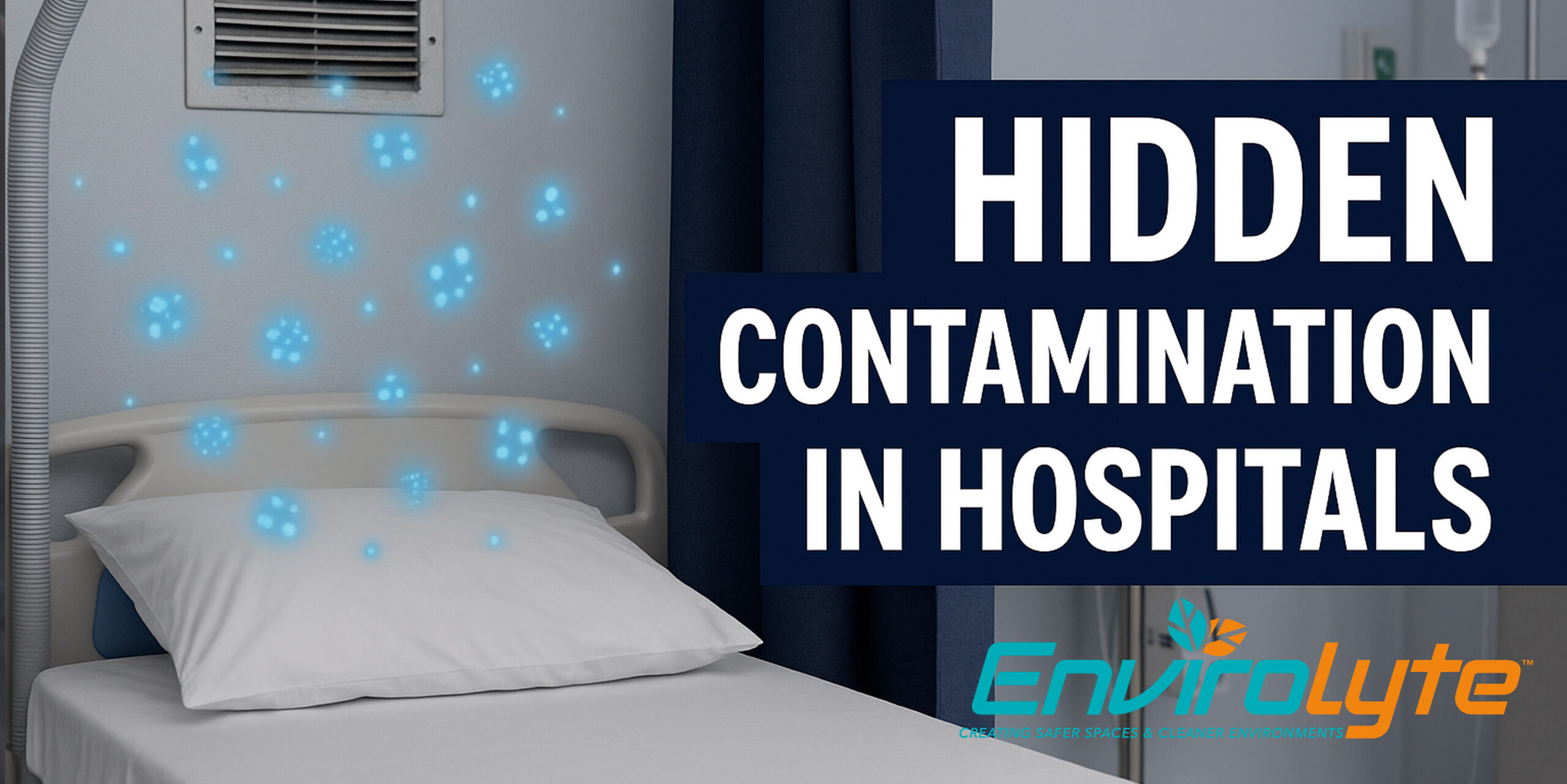
Every day, hospitals face a complex mix of viruses, bacteria, mold, biofilms, and persistent odor compounds. These contaminants do not stay only on obvious touch points. They embed in flooring, vents, curtains, mattresses, drains, and equipment. Yet many facilities still depend on harsh chemicals, ozone generators, or older disinfectants that were never designed to reach those hidden sources of contamination.
The result is a dangerous gap. Rooms can look clean while contamination continues to circulate, recolonize, and threaten patients, staff, and long term equipment integrity.
The Hidden Reality Inside “Clean” Hospital Rooms
Standard cleaning and disinfection routines are built around visible surfaces. Bed rails, side tables, workstations, and door handles are wiped and sprayed. Floors are mopped. On paper, the environment is compliant.
In practice, contamination often remains in places that are difficult to access, difficult to see, or impossible to treat with liquid products alone. These neglected zones become reservoirs that feed ongoing odors, recontamination, and avoidable risk.
Where Traditional Chemical Disinfectants Fail
Most hospital grade disinfectants were engineered for flat, nonporous surfaces. A hospital is not built that way. It is a dense, layered environment with complex airflow and thousands of material interfaces.
- Limited contact: Liquids only disinfect where they land, leaving untreated zones under beds, behind curtains, in cabinet crevices, and along ventilation paths.
- Poor penetration: Porous materials such as mattress fabrics, privacy curtains, carpeted areas, and rubber flooring are difficult or impossible to treat fully.
- Unrealistic dwell times: Many products require long wet contact times that rarely align with real hospital workflows.
- Residual toxicity: Harsh chemistries can leave fumes and residues that irritate respiratory systems, especially in vulnerable patients.
- Biofilm resistance: Biofilms inside drains, HVAC coils, prep rooms, and storage areas remain largely unaffected by traditional products.
- No air treatment: Surface disinfectants cannot address airborne microbes or odor compounds, allowing them to spread and recolonize.
Why Ozone Is Incompatible With Modern Hospitals
Ozone is sometimes marketed as a deep cleaning or odor removal solution. In a hospital, it introduces more problems than it solves.
- Human toxicity: Ozone is a respiratory irritant. Patients and staff must be removed from treated areas, which is often unrealistic.
- Patient vulnerability: Individuals with COPD, asthma, cardiac conditions, or weakened immune systems are especially at risk.
- Material damage: Ozone oxidizes plastics, gaskets, wiring, and sensitive electronics.
- Secondary irritants: It can react with chemicals and building materials, worsening indoor air quality.
- Poor coverage: Ozone does not reliably expand into corners, porous materials, or hidden spaces where contamination persists.
This is why ozone treated rooms often still have lingering odors and why pathogens can return even after treatment cycles.
Anolyte And Catholyte A Hospital Grade Alternative
Envirolyte’s on site generation technology separates water into two coordinated cleaning tools: anolyte and catholyte.
Anolyte based on hypochlorous acid
Anolyte is an HOCl based disinfectant with a neutral charge, giving it unique behavior in clinical environments.
- Whole environment reach: Effective for air, surfaces, fabrics, curtains, and complex geometries.
- Microbial efficacy: Inactivates bacteria, viruses, spores, and mold at the cellular level when used as directed.
- Biofilm penetration: Can help disrupt biofilms in drains, sinks, and high moisture zones.
- Safe for sensitive areas: Suitable for neonatal care, oncology, ICUs, OR prep rooms, and food service areas when protocols are followed.
Catholyte for cleaning and soil removal
Catholyte prepares surfaces for disinfection by breaking down organic soil that shields microbial contaminants.
- Organic load reduction: Improves disinfectant performance.
- Chemical replacement: Reduces reliance on harsh alkaline cleaners.
- Low residue profile: Leaves less chemical burden on equipment and materials.
Used together, anolyte and catholyte offer a safer, more complete alternative to multiple traditional chemicals.
HOCl Fogging How To Reach The Entire Environment
When HOCl is fogged, it behaves differently from ozone and standard spray-and-wipe disinfectants.
Neutral charge, fine mist, complete coverage
HOCl fogging produces an ultra fine aerosol that moves naturally with air currents. Because the solution is neutral in charge, it settles evenly instead of being repelled by surfaces.
- Under beds and stretchers.
- Behind privacy curtains and wall mounted equipment.
- Inside vents and around diffusers.
- Between mattress seams and under furniture bases.
- Within cracks, connectors, and narrow gaps.
Fogging treats air and surfaces simultaneously, helping reduce airborne microbes and odors in addition to surface contamination.
Flexible dosing for real hospital needs
- Routine pathogen control: Lower concentrations for daily environments.
- Deep odor and biofilm challenges: Higher calibrated concentrations for stubborn areas.
HVAC Integration For Whole Hospital Protection
Hospitals move large volumes of air quickly. When contaminants enter this airflow, they can travel across wings in minutes.
Under controlled conditions and appropriate protocols, HOCl solutions can be introduced through HVAC systems to support environmental hygiene strategies.
- Treat incoming and recirculated air.
- Maintain lower contamination baselines across wings.
- Reduce recontamination between terminal cleans.
- Enhance safety in high risk areas.
Operational Outcomes That Matter To Hospitals
Envirolyte systems help hospitals improve environmental hygiene while simplifying operations and reducing chemical burden.
Clinical and environmental gains
- Better infection control: More complete coverage supports HAI prevention programs.
- Odor reduction: Addresses the underlying sources, not just the symptoms.
- Equipment protection: Noncorrosive when generated and applied correctly.
Operational and staff benefits
- Simpler chemical inventories: One system replaces multiple traditional products.
- Faster room turns: More efficient workflows with broader coverage.
- Less PPE burden: Safer chemistry compared with ozone or harsh oxidizers.
A Safer Path Forward For Hospitals
Hospitals are under immense pressure to maintain safety in environments where contamination hides in places traditional products were never designed to reach.
Anolyte, catholyte, and HOCl fogging provide a more complete, better aligned approach to modern environmental hygiene and facility protection.
For leaders in environmental services, infection control, or hospital administration, it is worth asking:
- Are our products reaching the places where pathogens actually hide?
- Are we using chemistries that support staff health and patient safety?
- Are we relying on outdated methods when safer, more advanced solutions exist?
Explore Envirolyte Solutions For Your Hospital
Envirolyte USA helps hospitals implement anolyte, catholyte, and HOCl based systems that support whole environment cleaning and disinfection strategies.
Talk with our team about how these technologies can integrate with your existing protocols, HVAC infrastructure, and environmental services workflows.
