
High-Traffic Industrial Environments: How to Strengthen Sanitary Barriers
Busy Environments Demand Constant Attention
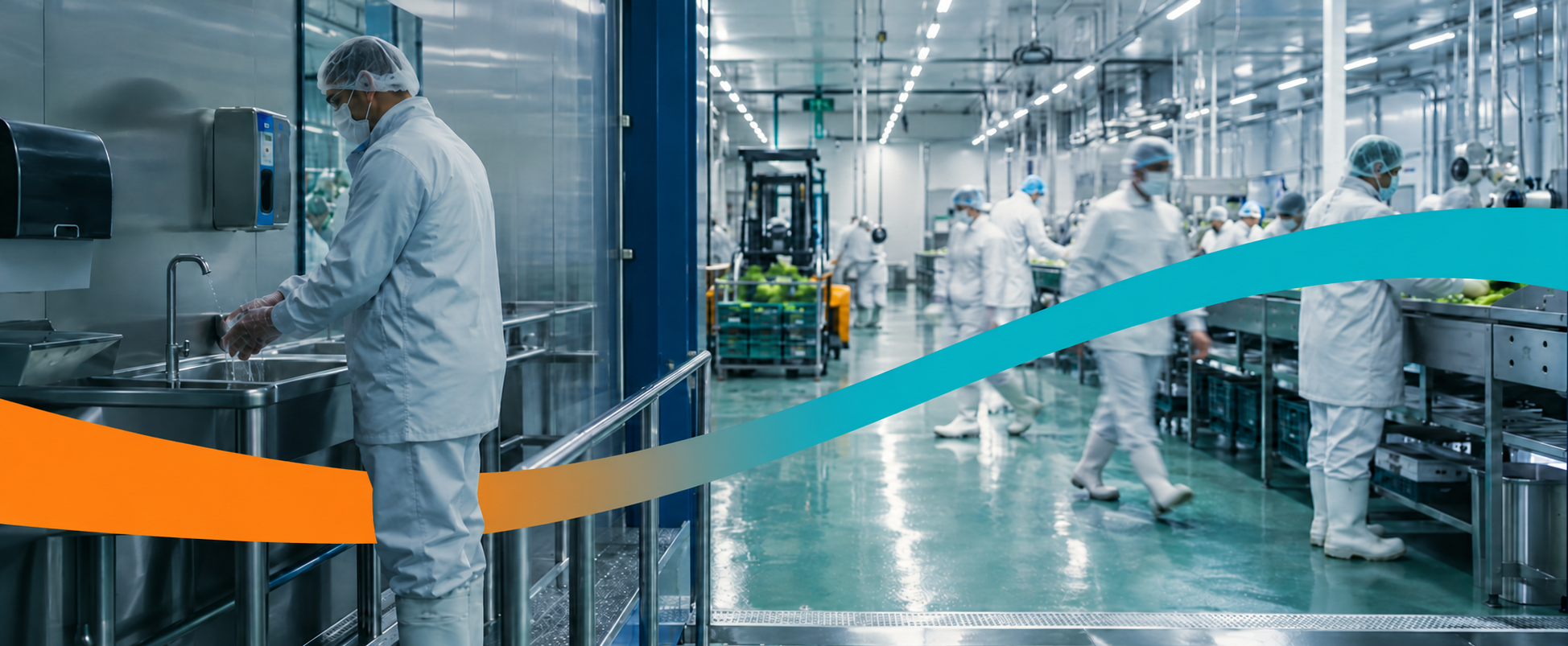
In a food, beverage, or animal protein plant, movement is part of the routine. Employees circulate between areas, forklifts carry loads, carts move from one environment to another, and different pieces of equipment come into contact with various areas throughout the day.
This dynamic is essential for keeping production going, but it also creates more opportunities for microorganisms to be carried from one point in the plant to another.
That is exactly why sanitary barriers have become increasingly important. Beyond meeting audit or legal requirements, they help preserve food quality, reduce operational risk, and prevent losses that could compromise an entire production run.
People Are Also Part of Microbiological Control
When we think about contamination, we usually think of equipment. However, the movement of employees themselves deserves attention.
Even with uniforms and PPE, hands, footwear, and clothing can carry microorganisms if hygiene protocols are not followed correctly.
The World Health Organization (WHO) points out that failures in hygiene practices remain among the main factors linked to the spread of microorganisms in food production environments. Likewise, the Codex Alimentarius highlights control of people’s movement as an important preventive measure within Good Manufacturing Practices (GMP) programs.
In plants with a large number of employees per shift, small failures can repeat countless times a day. That is why keeping procedures consistent makes a difference.
Equipment Can Also Spread Contaminants
Heavy traffic does not involve only people. Forklifts, plastic crates, carts, pallet jacks, and various utensils move constantly between production areas. If these items are not properly sanitized, they can carry residue and microorganisms into areas where they should not be.
This process is known as cross-contamination, considered one of the main challenges for food safety.
According to the Food and Agriculture Organization (FAO), preventing this kind of transfer is one of the most effective ways to reduce microbiological risk along the production chain.
Sanitary Barriers Go Beyond Footbaths
For a long time, talking about a sanitary barrier meant thinking only of footbaths and handwashing stations.
Today, the concept is much broader.
An effective strategy usually combines different measures working together, such as:
- Hand hygiene.
- Sanitization of boots and footwear.
- Access control between clean areas and higher-risk areas.
- Cleaning of mobile equipment.
- Sanitation of utensils.
- Frequent sanitization of contact surfaces.
- Defined protocols for employees entering and leaving.
The more consistent this set of actions is, the lower the chance of a contaminant circulating through the plant.
Frequency Matters Too
Another important point is that a single sanitization at the start of the shift does not always meet the needs of high-traffic environments.
Depending on the production process, some areas need reinforcement throughout the shift to keep microbial load under control.
This need tends to be more evident in segments such as:
- Meat processing plants.
- Dairies.
- Breweries.
- Beverage plants.
- Ready-to-eat food manufacturers.
The ideal frequency depends on the characteristics of each operation, the risk analysis, and the results of microbiological monitoring.
How ECA Technology Can Help
Among the solutions adopted by industry is Electrochemical Activation (ECA) technology, a sustainable sanitation technology that makes it possible to add more sanitization points with greater safety and operational control.
The solutions are produced from water, salt, and electricity directly at the industrial plant. This makes it possible to add sanitization points without depending only on constant replenishment of conventional sanitizers.
In practice, they can be used in different applications, such as:
- Sanitary barriers at access points.
- Boot sanitizing.
- Surface sanitization.
- Industrial equipment.
- Utensils.
- Plastic crates.
- Conveyor belts.
- Handling areas.
Beyond simplifying the operation, on-site production offers more predictability in the supply of sanitizing solutions, reduces the need to store large volumes of conventional chemicals, and gives more control over the plant’s sanitation routine.
This approach establishes ECA as a sustainable technology for industrial sanitation. The solutions, produced from water, salt, and electricity, are non-toxic and biodegradable, contributing to processes that are more efficient, predictable, and aligned with the current demands of the food industry.
Technology Complements a Strong Safety Culture
No technological solution replaces good manufacturing practices.
Periodic training, well-defined procedures, microbiological monitoring, and team commitment remain the foundation of any food safety program.
At the same time, innovative sanitation solutions make processes simpler, more standardized, and more efficient, helping reduce operational failures and making these standards easier to maintain in daily production.
In plants with heavy traffic of people, equipment, and materials, strengthening industrial sanitary barriers means reducing the opportunities for contaminants to spread between different areas.
More than meeting regulatory requirements, it is about creating processes that are safer, more consistent, and ready to sustain industrial productivity.
Strengthen your sanitary barriers without adding complexity.
See how producing sanitizing solutions on-site lets you add sanitization points with more control and less chemical storage.
