
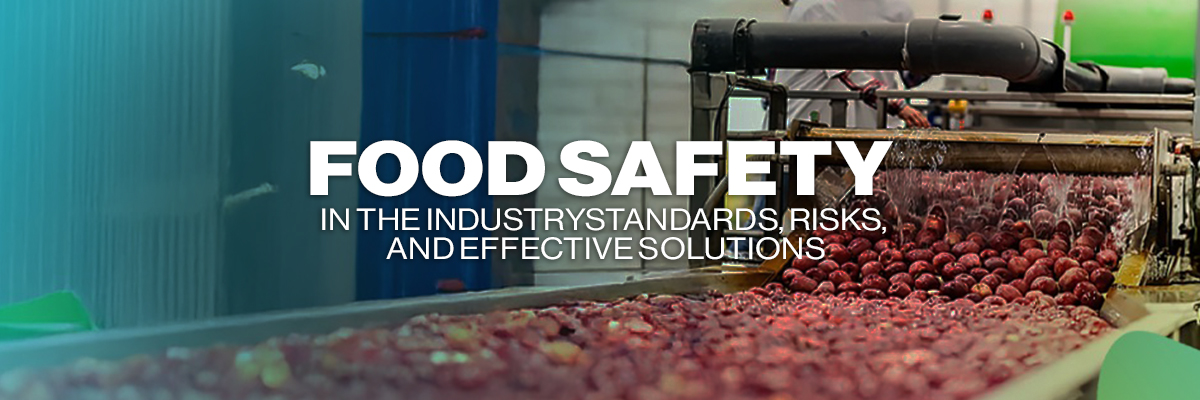
Food Safety in the Industry: Standards, Risks, and Effective Solutions
Introduction
In the food industry, safety is not only a regulatory requirement: it is the foundation of consumer trust. A single contaminated batch can generate multimillion-dollar recalls, lawsuits, and irreversible damage to brand reputation.
According to Food Safety Magazine, the average cost of a recall in the sector can exceed $10 million, not including the impact on a company’s image.
To avoid situations like this, it is essential to align technology, standards, and sustainable practices. This is where innovative solutions, such as on-site generation of sanitizers, gain prominence.
Main Food Safety Standards in the Industry
Regulatory compliance ensures that every stage of the production process is auditable and safe. The most recognized standards include:
- FSSC 22000: A robust food safety management system.
- ISO 22000: Standardizes the entire production chain.
- HACCP: Identification and control of critical points.
- FDA and EPA: U.S. regulatory frameworks that may apply to technologies such as HOCl depending on product registration, intended use, concentration, and label directions.
In the United States, hypochlorous acid (HOCl) may be used in food processing applications when the specific product and use conditions comply with applicable FDA food contact notifications, EPA label requirements, and facility-specific food safety programs.
Common Risks and Failures in Sanitary Control
Even with strict standards, many challenges still compromise production:
- Cross-contamination caused by inadequate sanitation.
- Chemical residues that require rinsing and increase water consumption.
- Manual processes that create inconsistencies and the risk of negative audit outcomes.
Only those who have faced a line shutdown due to a CIP (Cleaning in Place) failure understand the financial impact of these situations.
Innovative Technologies for Food Safety
On-Site Generation of Sanitizers
Envirolyte transforms water, salt, and electricity into two agents:
- Anolyte (HOCl): A neutral-pH antimicrobial solution that is effective against viruses, bacteria, fungi, and biofilm as part of its antimicrobial activity when generated and applied within validated operating parameters.
- Catholyte: A degreasing solution that saponifies fats, making them easier to remove with water during pre-cleaning.
No transportation, no replenishment, and reduced operational risk.
Residue Reduction and Rinse Elimination
With HOCl, there are no toxic residues when the solution is produced and applied within approved operating ranges. This can eliminate the rinse step in permitted no-rinse applications and reduce water consumption by up to 30% in CIP processes.
In addition to frozen vegetables, meat and dairy industries have reported significant gains in sanitation efficiency with this technology.
Sustainable Practices and Regulatory Compliance
In addition to being safe when properly specified and used, modern solutions are sustainable:
- Reduction in water and energy.
- Elimination of aggressive chemical products.
- Lower waste generation.
These practices contribute to clean production and may support compliance with U.S. food safety and sanitation expectations when validated within the facility’s program and aligned with FDA, EPA, USDA-FSIS, and applicable state requirements.
How to Implement Improvements in Your Industrial Plant
Essential Steps
- Evaluate your current line: identify critical sanitation points.
- Implement on-site generation: reduce steps and risks.
- Train the team: ensure standardization.
- Monitor data: use indicators such as ORP and pH.
- Audit continuously: maintain compliance with standards.
Plants that adopt on-site generation report significant reductions in CIP costs and stronger performance in food safety audits.
Comparison with Traditional Methods
| Aspect | Conventional Sanitization | Envirolyte (HOCl) |
|---|---|---|
| Chemical residues | High | None when properly applied |
| Need for rinsing | Yes | No in permitted no-rinse applications |
| Transportation cost | High | Zero for generated solution transport |
| Impact on audits | Variable | Positive when validated and documented |
ROI Simulation
Based on average industry data:
- Savings on chemical products: $8,000/year
- Reduction in water consumption: $5,000/year
- Savings on CIP time: $4,440/year
- Estimated total: $17,440/year
Note: estimated values based on industry averages. Actual results may vary according to the operation.
FAQ
Does HOCl replace bleach?
Yes. In many applications, HOCl can replace conventional chlorine-based sanitizers when the product, concentration, and application method are appropriate for the intended use. It can be an excellent option because it is non-toxic at approved use levels and supports more sustainable operations.
Is it accepted in audits?
Yes, when properly validated and documented. The technology aligns with FSSC 22000, ISO 22000, and HACCP principles, and its use should be supported by applicable FDA, EPA, USDA-FSIS, state, and customer-specific requirements.
Does it help reduce operating costs?
Yes. In a mid-sized plant, average reductions may reach an estimated $17,440 per year.
Conclusion
Food safety is not only about avoiding risks: it is about adopting solutions that combine compliance, efficiency, and sustainability. Envirolyte is the technological solution capable of transforming your production process and eliminating operational bottlenecks.
Clean, safe, and validated production starts now.
Food safety failures usually begin before the audit.
If your plant is still relying on chemical deliveries, manual dilution, repeated rinsing, and inconsistent CIP controls, the risk is already built into the process. Review where on-site generation can simplify sanitation, reduce variability, and support a cleaner food safety program.
