
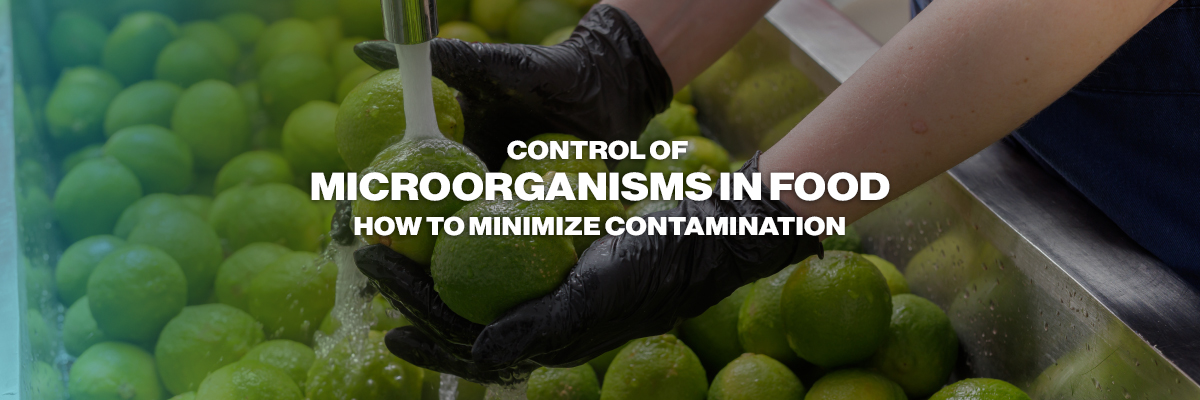
Control of Microorganisms in Food: How to Minimize Contamination
Introduction
Ensuring food quality and safety is a constant challenge in the industry. One of the most critical points is the control of microorganisms, since bacteria, fungi, and viruses can compromise not only the flavor and shelf life of products, but also consumer health.
Contamination can occur at several stages of the production chain: from raw material handling to storage and transportation. For this reason, minimizing risks requires strict hygiene protocols, as well as the adoption of technologies that help combat contaminating agents.
Main Microorganisms in Food
Among the most common are:
- Salmonella spp.: associated with meat, eggs, and derivatives.
- Listeria monocytogenes: resistant to cold, it multiplies at low temperatures; in addition, it can develop and become very dangerous in refrigerated environments.
- Escherichia coli (E. coli): although some strains are harmless, other variants, such as E. coli O157:H7, are harmful and responsible for foodborne outbreaks.
- Molds and yeasts: impair sensory quality and reduce the shelf life of foods.
These microorganisms can cause foodborne diseases, with direct impacts on public health and on the reputation of companies.
Strategies to Minimize Contamination
The control of microorganisms depends on continuous preventive measures. Among the main practices are:
- Good Manufacturing Practices (GMP): proper hygiene of surfaces, equipment, and utensils.
- Temperature control: rigorous monitoring of cooling, freezing, and cooking.
- Hazard Analysis and Critical Control Points (HACCP): an internationally recognized system for identifying risks and establishing control measures.
- Team training: ongoing training of employees on hygiene in food production and safe handling.
Innovative Solutions for Hygiene
Traditionally, the sector uses aggressive chemical sanitizers, which can leave unwanted residues and impact the environment. In this scenario, Envirolyte technology emerges as a sustainable alternative:
The company applies the water electrolysis process, which generates hypochlorous acid (HOCl) and sodium hydroxide (NaOH) from water, salt, and electricity. This reaction, known as saline electrolysis, results in solutions that are highly effective against microorganisms and safe for use in food environments.
In addition to reducing contamination, the use of these solutions contributes to more sustainable and economically viable practices in the industry.
Food safety depends on sanitation systems that reduce microbial risk without adding chemical burden.
If contamination control is a recurring concern in your food operation, the next step is to evaluate how on-site generation of HOCl and NaOH can support safer hygiene protocols, reduce reliance on aggressive sanitizers, and improve consistency across production, storage, and handling environments.
