
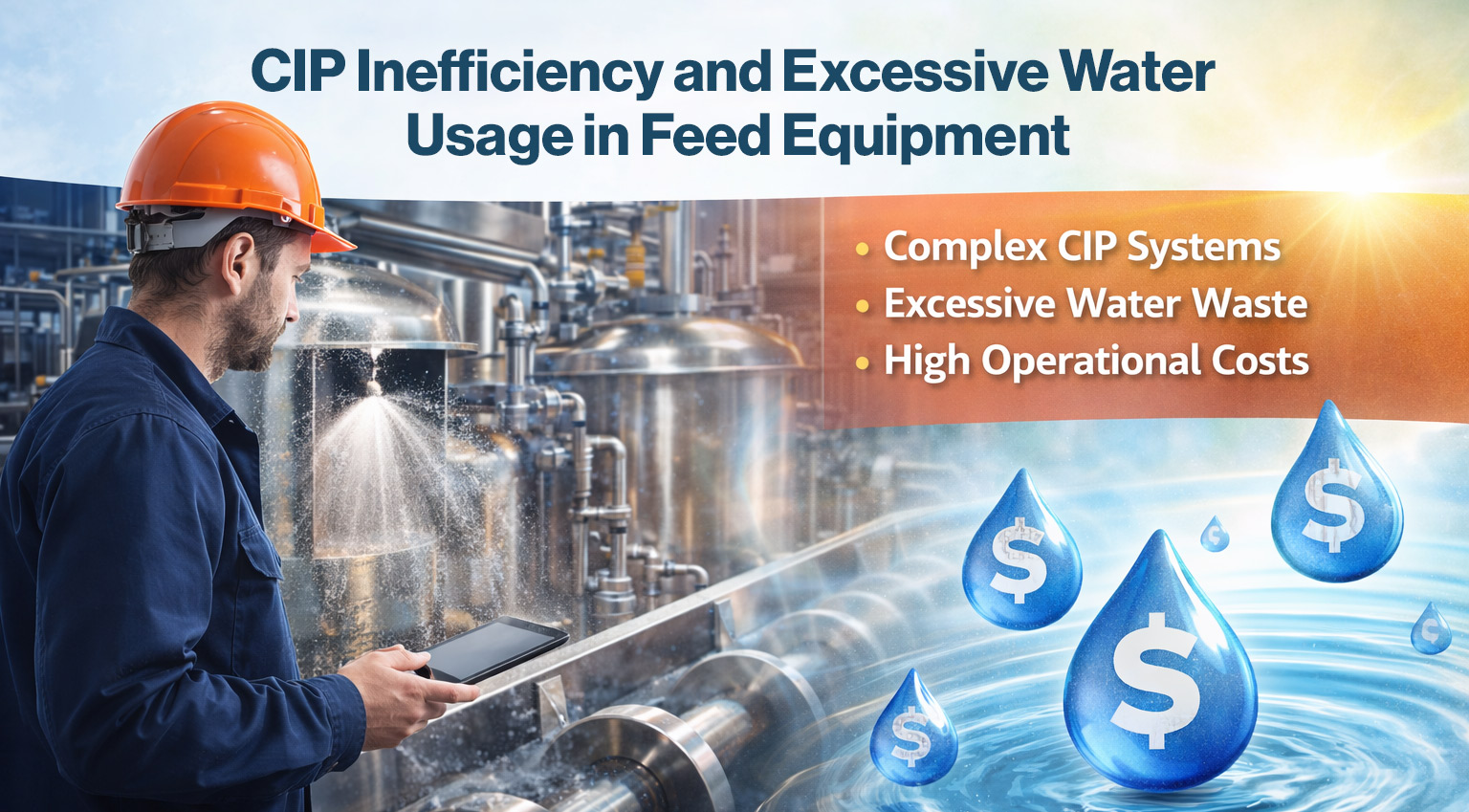
CIP Inefficiency and Excessive Water Usage in Feed Equipment
Why Traditional CIP Programs Over consume Resources, and How Envirolyte USA Simplifies the Process
Clean in Place CIP systems are foundational to sanitation in animal food ingredient and feed handling facilities. Conveyors, mixers, augers, tanks, and piping rely on CIP protocols to remove organic soils and control microbial risk without disassembly. Yet despite decades of optimization, many feed facilities continue to struggle with long, water intensive, labor heavy CIP cycles that still produce inconsistent microbial outcomes.
At Envirolyte USA, CIP inefficiency is a recurring operational theme observed across feed mills and ingredient processors. The issue is not a lack of effort or automation, it is a systemic dependency on multi step chemical compensation rather than targeted microbial control.
This article examines why conventional CIP programs consume excessive water and labor, the root causes behind repeated cycles, and how Envirolyte USA enables simplified CIP architectures that reduce water use, cycle time, and operational cost while improving sanitation reliability.
The Problem: CIP Systems That Do More, But Achieve Less
In many feed facilities, CIP programs are characterized by:
- Extended cycle durations, often running hours per circuit
- High water consumption driven by repeated rinse stages
- Significant labor involvement for monitoring, validation, and rework
- Unreliable microbial outcomes, despite aggressive chemistry
This inefficiency becomes especially costly in high throughput operations where equipment downtime directly impacts production capacity and scheduling.
Root Causes of CIP Inefficiency
1. Multi Step Chemical Dependency
Traditional CIP programs often rely on a sequence such as:
- Pre rinse
- High strength caustic wash
- Intermediate rinse
- Acid wash
- Final rinse
- Sanitizer step
Each step exists largely to compensate for the limitations of the previous one. Caustics remove fats and proteins but do not reliably eliminate biofilms, acids remove mineral scale but add little microbial control, sanitizers then attempt to manage what remains.
This layered approach increases:
- Cycle length
- Water usage
- Energy demand, heated solutions
- Chemical inventory complexity
2. High Rinse Volumes Driven by Residue Concerns
Aggressive detergents and sanitizers, particularly caustics, acids, quats, and phenolics, require extensive rinsing to prevent chemical residues on feed contact surfaces.
In practice:
- Rinse effectiveness varies by equipment geometry and flow dynamics
- Operators often extend rinse times to be safe
- Water usage escalates rapidly without guaranteeing residue removal
This creates a sanitation paradox. More water does not always equal better sanitation, but it always increases cost.
3. Repeated CIP Cycles Due to Incomplete Sanitation
When CIP programs fail to adequately control biofilms or embedded microbial populations, facilities experience:
- Recurring Salmonella or indicator organism detections
- Re cleaning of the same circuits
- Additional labor and water consumption
- Lost production time
Scientific literature consistently shows that surface level cleaning without biofilm disruption leads to rapid recontamination, forcing repeated CIP interventions rather than solving the underlying problem.
The Cost of Inefficient CIP
Beyond water and chemical costs, inefficient CIP programs affect:
- Energy consumption, especially where heated caustics and long pump runtimes are used
- Labor allocation, including night sanitation crews and supervisory oversight
- Asset wear, as prolonged exposure to aggressive chemistry accelerates corrosion and seal degradation
- Sustainability metrics, increasingly scrutinized by customers and regulators
These hidden costs often exceed the visible expense of water and chemicals alone.
How Envirolyte USA Simplifies CIP Architecture
Envirolyte USA addresses CIP inefficiency by reducing the need for chemical compensation altogether.
Fewer Chemical Steps
Envirolyte’s electro activated solutions provide effective antimicrobial action at low concentrations and neutral to mild pH, allowing facilities to simplify CIP sequences.
In many applications, this results in:
- Fewer chemical stages
- Reduced reliance on alternating caustic and acid cycles
- Elimination or reduction of high residue sanitizers
Reduced Rinse Requirements
Because Envirolyte USA solutions:
- Do not leave persistent chemical residues
- Break down into benign saline components after use
Rinse requirements are often shorter and more predictable, reducing water consumption without increasing risk.
Shorter Total Cycle Time
By improving sanitation efficacy within each cycle, Envirolyte USA helps facilities:
- Achieve microbial control faster
- Reduce the need for repeat cleaning
- Return equipment to service sooner
This translates directly into higher equipment availability and throughput.
Operational Results Observed with Envirolyte USA
Facilities integrating Envirolyte USA into CIP programs commonly report:
- Lower total water consumption per CIP cycle
- Reduced labor hours associated with sanitation and rework
- Lower energy usage due to shorter runtimes and fewer heated steps
- Improved microbial consistency, reducing corrective actions
Importantly, these gains are achieved without compromising sanitation outcomes, and often while improving them.
CIP Efficiency Is a Design Choice, Not a Fixed Constraint
CIP inefficiency in feed handling systems is rarely caused by inadequate automation or operator performance. It is typically the result of chemical heavy sanitation architectures designed to compensate for limited efficacy, rather than eliminate contamination at its source.
Envirolyte USA enables a shift from complex, water intensive CIP programs toward simpler, more efficient sanitation strategies. By reducing chemical aggression, rinse dependency, and cycle repetition, facilities can lower operational costs while improving microbial control and sustainability performance.
References
- Clean in Place CIP Systems in Food and Beverage Processing: Design, Validation, and Optimization. https://www.csidesigns.com/blog/articles/5-steps-in-a-common-food-dairy-beverage-clean-in-place-cycle
- Cleaning and Sanitizing in Food Processing Operations. University of Florida IFAS Extension. https://edis.ifas.ufl.edu/publication/FS077
- Biofilm Formation and Control in Food Processing Environments. Frontiers in Microbiology. https://www.frontiersin.org/articles/10.3389/fmicb.2018.00898/full
- Water and Energy Efficiency in CIP Systems for Food Processing. Journal of Cleaner Production. https://www.sciencedirect.com/science/article/pii/S0959652621003340
Learn More About CIP Efficiency in Feed Operations
If you are evaluating sanitation strategies that reduce water use and cycle time while maintaining hygiene objectives, our team can help you assess how electro activated solutions fit within your operating conditions and verification requirements.
