
Hidden Sanitation Costs: How Fragmented Chemical Purchasing Reduces Operational Efficiency
Hidden Sanitation Costs: How Fragmented Chemical Purchasing Reduces Operational Efficiency Table of Contents Introduction Where Hidden Costs Are Created The False Economy of the Lowest Price Regulatory Risk and Loss of Predictability When Sanitation Stops Being an Expense and Becomes a Strategy Conclusion Introduction In industry, sanitation is still often treated as a recurring operating […]
Sustainability That Pays the Bill: When Operational Efficiency Becomes a Competitive Advantage

Sustainability That Pays the Bill: When Operational Efficiency Becomes a Competitive Advantage Table of Contents Introduction Fragmented Sustainability Creates Operational Distortion Operational Efficiency as an Environmental Variable Occupational Safety as a Margin Component Operational Predictability Reduces Hidden Cost Measurable Sustainability Technology as a Vector for Simplification Conclusion Introduction Sustainability has become a permanent part of […]
What Craft Brewers Told Us About CIP in 2026
What Craft Brewers Told Us About CIP in 2026 Wastewater pressure, rising sanitation cost, sustainability demands, and the shift toward on-site sanitation production What We Heard in Philadelphia You see it when a tank is still in CIP and the next batch is ready. Rinses continue past the point where residue is gone, water keeps […]
Advanced CIP Optimization for Craft Breweries
Advanced CIP Optimization for Craft Breweries Biofilm Control, Concentration Stability, Rinse Reduction, and Operational Consistency Your Cellar Is Ready. CIP Still Isn’t. You finish a batch, expect the tank to turn, and the cycle keeps running. Water continues moving through the vessel. Pumps stay on. In some breweries, heat is still being applied. The […]
Brewery Sanitation Inefficiencies and the Structural Limits of Modern CIP Optimization
Brewery Sanitation Inefficiencies and the Structural Limits of Modern CIP Optimization If sanitation defines your beer’s quality, why is it still treated as a cleaning task instead of a control system? Brewery Sanitation Is Quietly Controlling Your Capacity If you have ever walked into the cellar expecting a tank to be ready and found it […]
Inconsistent Sanitation Outcomes Between Shifts
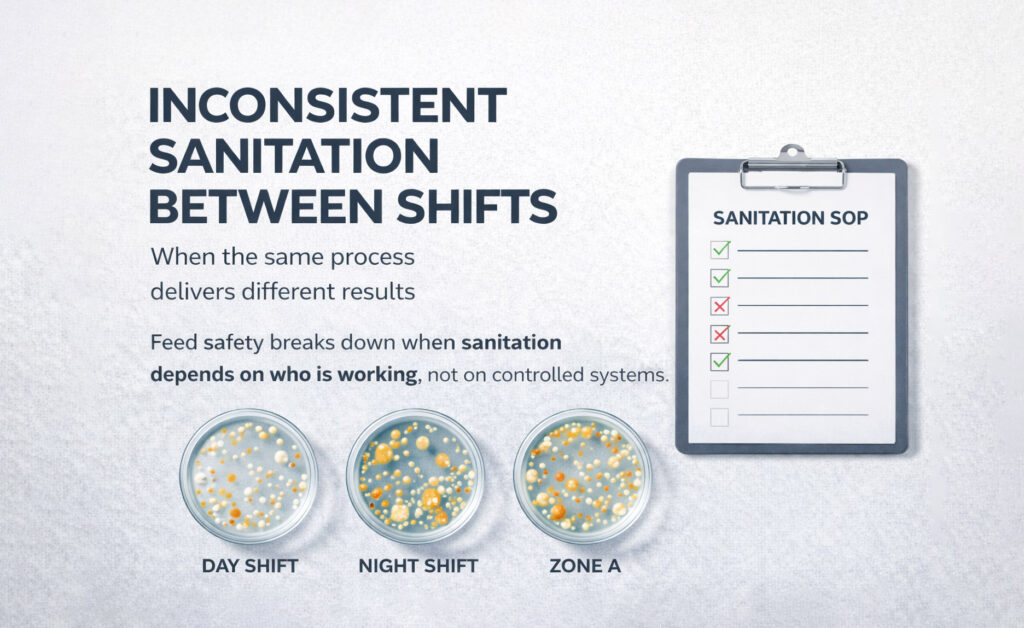
Inconsistent Sanitation Outcomes Between Shifts Why Variability Undermines Feed Safety, and How Envirolyte USA Restores Control In animal food ingredient and feed handling facilities, sanitation programs are often well designed on paper, validated chemicals, written SOPs, defined CIP parameters. Yet in practice, sanitation effectiveness frequently varies by operator, by shift, and by location within the […]
Worker Safety and Chemical Handling Risks in Feed and Ingredient Facilities
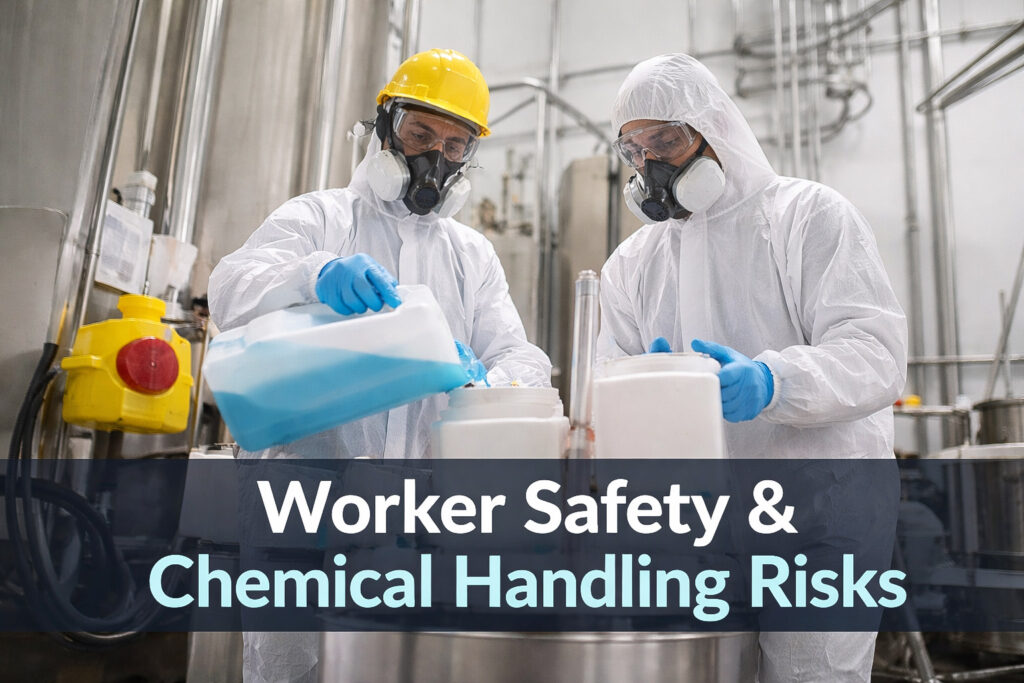
Worker Safety and Chemical Handling Risks in Feed and Ingredient Facilities Why Traditional Sanitation Exposes Workers, and How Envirolyte USA Reduces That Risk Sanitation programs in animal food ingredient and feed handling facilities are designed to protect product safety. Yet, in many operations, they do so at the expense of worker safety. Strong acids, caustics, […]
CIP Inefficiency and Excessive Water Usage in Feed Equipment
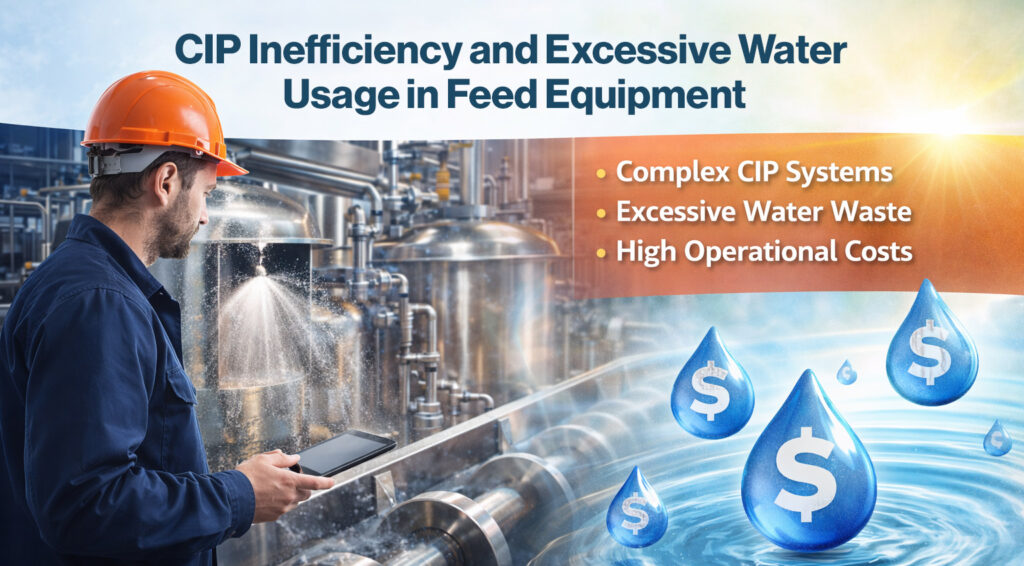
CIP Inefficiency and Excessive Water Usage in Feed Equipment Why Traditional CIP Programs Over consume Resources, and How Envirolyte USA Simplifies the Process Clean in Place CIP systems are foundational to sanitation in animal food ingredient and feed handling facilities. Conveyors, mixers, augers, tanks, and piping rely on CIP protocols to remove organic soils and […]
Residue and Feed Safety Risks
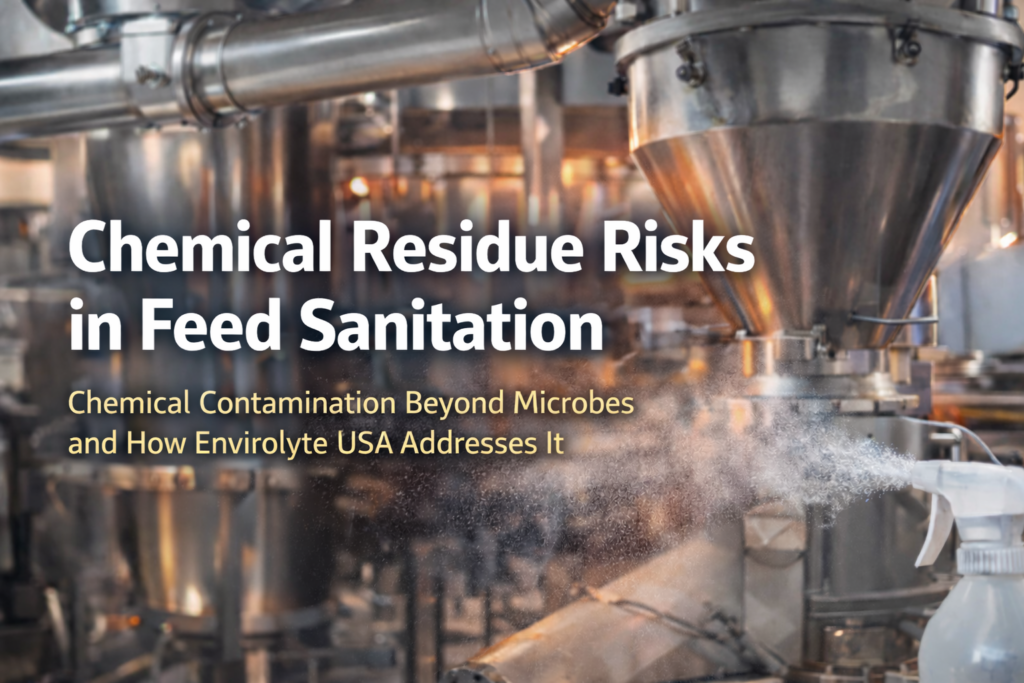
Residue and Feed Safety Risks: Chemical Contamination Beyond Microbes and How Envirolyte USA Addresses It In feed mills and animal food ingredient facilities, sanitation is typically framed around microbial control, Salmonella, Listeria, molds, and other pathogens that threaten feed safety. However, there is a parallel issue that is chemical, not biological: residual sanitizers left on […]
Corrosion in Feed Handling Equipment
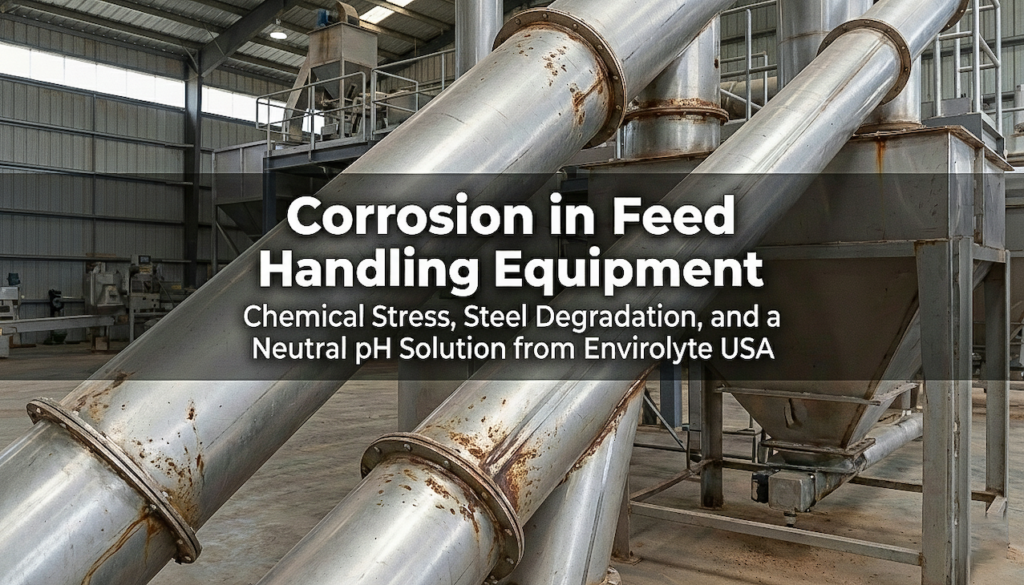
Corrosion in Feed Handling Equipment Chemical Stress, Steel Degradation, and a Neutral pH Solution from Envirolyte USA Stainless steel supports hygienic operations in feed and ingredient processing, but aggressive sanitation chemistry can accelerate localized corrosion and equipment degradation.In animal food ingredient and feed processing environments, stainless steel is the material of choice for conveyors, mixers, […]
