
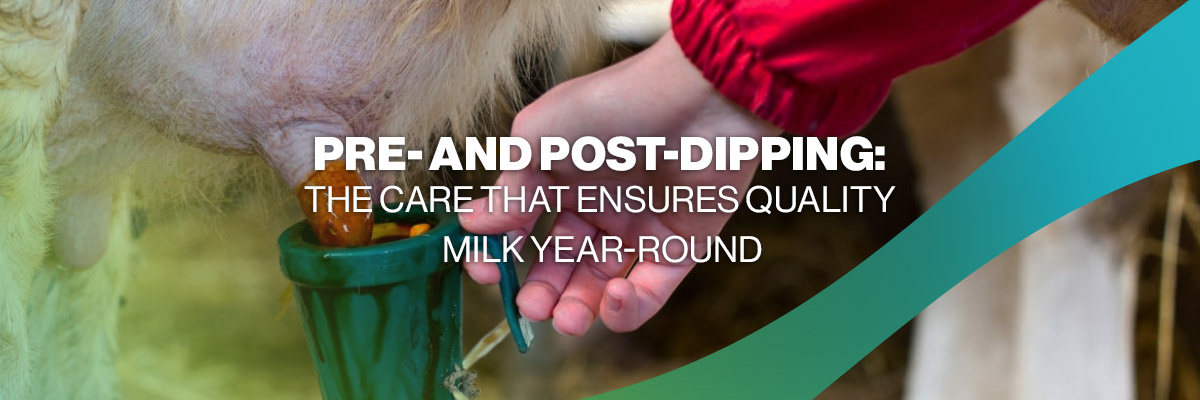
Pre- and Post-Dipping: The Care That Ensures Quality Milk Year-Round
Introduction
Among all the practices in the dairy routine, few influence milk quality as directly as teat care before and after milking. Pre-dipping and post-dipping function as the main protective barrier against contaminating agents, reducing the incidence of environmental mastitis, caused by pathogens present in the environment, such as E. coli and Streptococcus uberis, and contagious mastitis, transmitted between animals, mainly Staphylococcus aureus and Streptococcus agalactiae. In this way, they support consistent SCC levels across the different seasons.
When these procedures are applied in a standardized way, the entire milking dynamic becomes safer and more predictable. The risks of cross-contamination decrease, and the farm maintains a higher level of biosecurity even during critical periods, such as high temperatures, intense humidity, or outbreaks of microorganisms in the environment.
What Pre-Dipping Is and How It Protects Milk
Pre-dipping is the cleaning and sanitizing step performed before milking, in which the sanitizer requires a minimum contact time with the teats of 20 to 30 seconds before drying. Its purpose is to remove soil and reduce the microbial load present on the teat skin, preventing contaminants from coming into contact with the milk in the first minutes of the process. This initial care ensures a more uniform routine, with fewer failures and greater control over environmental mastitis cases.
In addition to the significant reduction of microorganisms, pre-dipping prevents residues from the floor, dust, environmental particles, and natural dirt from the cow from being transferred to the equipment. When the solution’s contact time is respected and the application is homogeneous, the sanitary effect is proven by the reduction of microbial load and lower risk of milk contamination, directly reflecting the quality of the raw material.
The Importance of Post-Dipping for Biosecurity
Immediately after the teat cups are removed, the teat canal takes approximately 20 to 30 minutes to close completely, a period during which the risk of pathogen entry increases. Post-dipping forms the protective layer the mammary gland needs to pass through this moment of greater vulnerability.
Post-dipping reduces the occurrence of contagious mastitis and prevents biosecurity failures as the animal moves back to the environment. When there is complete teat coverage and the use of products with prolonged action, the risk of new clinical cases drops significantly and SCC tends to remain more stable throughout the year.
How to Maintain Pre- and Post-Dipping Efficiency Across the Seasons
Climate changes directly influence management. High temperatures favor microbial growth, and cold periods can compromise teat drying. For this reason, protocol standardization is indispensable for maintaining consistent results.
A trained team, respect for the solutions’ action time, and the guarantee of full teat coverage are fundamental pillars. It is also important that the products used have proven action and that the milking equipment is always clean. Continuous evaluation of indicators such as individual SCC and bulk tank SCC provides data that help correct failures quickly, especially on farms that face recurring mastitis challenges.
Technologies That Strengthen Pre- and Post-Dipping
Sanitary solutions have evolved and now allow farms to adopt safer and more sustainable protocols. Envirolyte’s sustainable sanitation technology, which uses an electrolyzed water solution for disinfection, delivers broad-spectrum microbiological action with low toxicity and excellent operational safety.
HOCl can be incorporated into both the pre-dipping and post-dipping stages, provided it is part of a validated protocol and technically monitored. Its stability, speed of action, and safety for operators stand out in processes that require rigorous standardization and predictable results.
Direct Benefits for Milk Quality
When pre- and post-dipping are performed correctly, the effects appear quickly in the daily life of the farm. There is a drop in mastitis rates, a reduction in discarded milk, lower antibiotic use, and improved productive performance of the herd. In addition, properties that maintain consistent protocols more easily meet the requirements of dairies, audits, certifications, and quality-based payment programs.
In the long term, the result is a safer production environment, healthier animals, and more stable sanitary indicators. These factors elevate the final quality of the milk and strengthen the farm’s competitiveness throughout the entire year.
Your milking routine should protect milk quality before contamination becomes a recurring problem.
Pre- and post-dipping protocols only deliver consistent results when the sanitizer, contact time, coverage, and operational routine work together. If mastitis pressure, SCC variability, or seasonal contamination challenges are affecting your dairy operation, Envirolyte can help evaluate how electrolyzed water technology fits into a safer and more predictable teat hygiene protocol.
