
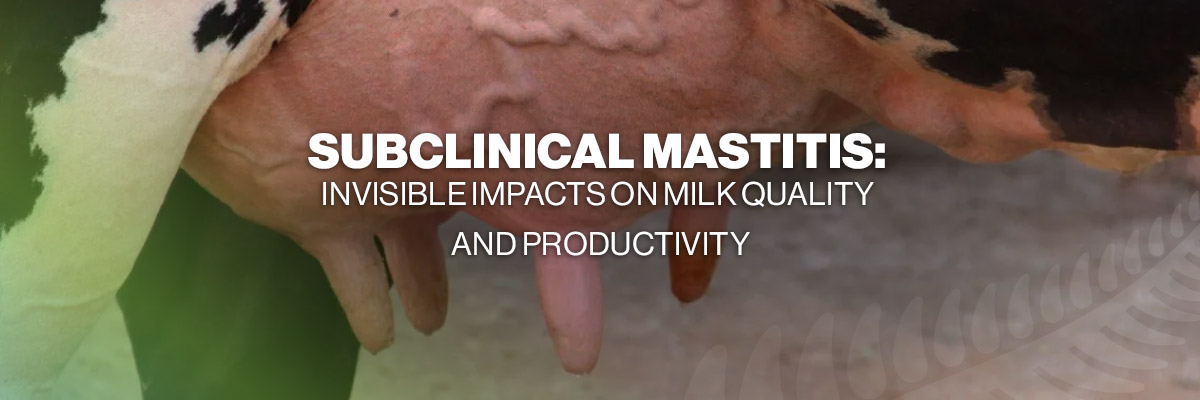
Subclinical Mastitis: Invisible Impacts on Milk Quality and Productivity
Subclinical mastitis is one of the greatest health challenges in modern dairy farming precisely because of what makes it more dangerous: it happens silently. Unlike clinical mastitis, there are no visible changes in the udder, in the milk, or in the animal’s behavior. There is no apparent pain and no clear warning signs.
In practice, this allows the problem to advance without being noticed. When the first indicators appear, such as changes in quality parameters, subclinical mastitis is often already established in the herd. Even without external signs, it affects milk composition, raises the somatic cell count, and compromises productivity. The result appears in the form of economic losses, discarded milk, and difficulty meeting the standards required by dairies and regulatory bodies.
What Is Subclinical Mastitis
Subclinical mastitis is an inflammation of the mammary gland caused, in most cases, by microorganisms that settle in the teat canal and internal udder tissues. Unlike the clinical form, there are no clots, changes in milk color, or evident signs in the animal.
The main indicator of the disease is an increase in somatic cell count (SCC). This increase reflects the body’s inflammatory response to the presence of infectious agents. For this reason, subclinical mastitis is usually identified only through laboratory analyses or indirect tests, when the impact on milk quality is already underway.
Why Subclinical Mastitis Compromises Milk Quality
Even without visible manifestations, subclinical mastitis causes important changes in milk quality. Inflammation directly interferes with the synthesis of fat, protein, and lactose, reducing industrial yield and affecting the sensory and microbiological characteristics of the final product.
In addition, the continuous presence of microorganisms in the udder increases the risk of cross-contamination during milking. Without consistent cleaning and sanitation protocols, these agents spread easily among animals, equipment, and surfaces, creating a cycle of reinfection that is difficult to interrupt.
Factors That Favor Subclinical Mastitis
The installation and persistence of subclinical mastitis are linked to a combination of operational and sanitary factors. Among the main ones are:
- Failures in cleaning and sanitizing teats before and after milking
- Use of inadequate products or incorrect dilution
- Water with compromised microbiological quality
- Poorly sanitized milking equipment
- Incorrect management between groups
- Environments with a high organic load and excess moisture
These conditions create a favorable scenario for the survival and multiplication of microorganisms, making disease control increasingly complex over time.
The Role of Cleaning and Sanitation in Controlling Subclinical Mastitis
Cleaning and sanitation are key elements in controlling subclinical mastitis. The adoption of sustainable sanitation technology makes it possible to significantly reduce the microbial load and makes it harder for microorganisms to reach the teat canal and establish themselves in the mammary gland.
This goes far beyond pre- and post-dipping. It also involves proper sanitation of milking equipment, lines, contact surfaces, and strict control of the quality of the water used throughout the process. When these steps are not standardized, monitored, and frequently reviewed, the risk of sanitary failures increases silently.
In this context, the use of electrolyzed water solution for disinfection has gained prominence by offering high microbiological efficacy, safety for animals, and lower chemical impact compared with traditional sanitizers.
Why Control Must Be Continuous
Because it is a condition that does not show evident signs, subclinical mastitis requires constant and preventive control. Waiting for clinical signs or results outside the standard means acting reactively, when part of the loss has already occurred.
The combination of microbiological monitoring, consistent cleaning and sanitation protocols, and the use of appropriate sanitizers makes it possible to reduce the incidence of the disease, protect milk quality, and meet the requirements for sustainable disinfection in the food industry, from farm to processing. In a silent problem, control must also be continuous.
Subclinical mastitis control starts with consistent sanitation.
Every sanitation failure in milking routines, water quality, equipment, and contact surfaces increases the risk of silent contamination. Talk to Envirolyte USA about sustainable disinfection solutions designed to support safer, more consistent hygiene from farm to processing.
