
What Craft Brewers Told Us About CIP in 2026
Wastewater pressure, rising sanitation cost, sustainability demands, and the shift toward on-site sanitation production
What We Heard in Philadelphia
You see it when a tank is still in CIP and the next batch is ready. Rinses continue past the point where residue is gone, water keeps moving, heat stays on, and time gets absorbed into the cycle whether it is needed or not. CIP is one of the few systems that continues to add cost after the cleaning work is done.
Across breweries of different sizes, the same pressures kept coming up in Philadelphia: wastewater, rising cost, and sustainability. The discussion kept returning to cleaning cycles that run longer than necessary, use more water than expected, and create downstream instability through chemical-heavy processes that repeat without meaningful change.
The system is still built to run longer, use more, and rely on more handling than the process actually requires, and that gap is where cost builds.
Wastewater Is Becoming Harder to Control and More Expensive to Discharge
Wastewater has become one of the most difficult parts of brewery operations to keep under control, directly influencing how CIP is managed and how risk is handled at the drain. Across a normal production day, discharge can shift from acidic fermentation losses to highly alkaline CIP output, driving pH swings from roughly 3 to 12 while carrying organic load from yeast, trub, product loss, elevated COD, BOD, suspended solids, and temperature spikes.
That variability is exactly what regulators are targeting. Discharge is measured against defined limits across pH, organic load, solids, nutrients, and temperature, and when those limits are exceeded the consequences are immediate and financial:
- Surcharge costs increase based on load.
- Violations trigger corrective actions and oversight.
- Discharge can be restricted until conditions are corrected.
The operational reality intensifies the problem, with breweries relying on continuous adjustment to stay within limits. Chemical is added, tested, and adjusted repeatedly, turning wastewater management into a trial-and-error process where more chemistry is used to correct variability created upstream.
That approach increases handling, expands chemical inventory, and drives cost without stabilizing the discharge itself. More chemical often gets used than necessary just to stay within limits, while what leaves the drain remains inconsistent and subject to measurement, pricing, and enforcement every day.
Cost, Time, and Chemistry Are Compounding Inside the Same System
Cost pressure is coming from everywhere at once, and CIP is where those pressures converge. Rising raw material costs, increasing chemical prices, fuel surcharges, and tighter consumer spending all feed directly into daily operations, where CIP multiplies those increases across every cycle instead of absorbing them.
Water is purchased, heated, and discharged, while chemicals are purchased, stored, mixed, and neutralized. Across hundreds of cycles per year, those repeated inputs accumulate into one of the largest recurring cost centers in the operation.
This compounding effect is structural. Most CIP programs are built on fixed time rather than actual condition, which keeps the system running after the cleaning work is complete and pushes additional water, heat, and chemistry through every cycle by design.
Multiple products, suppliers, storage, handling, and dosing add another layer of cost and complexity to a process that already repeats daily, making it more expensive to maintain as external costs rise.
The Industry Response So Far
Breweries have made real progress on CIP, but most improvements still sit inside the same operating model. Programs have shortened cycles, reduced acid frequency, shifted to cold sanitation where possible, added sensors to cut rinses closer to endpoint, and, in larger sites, recovered water between steps.
Those changes deliver measurable gains through shorter cycle times, lower steam demand, tighter water use, and reduced annual water cost in well-instrumented systems. The limitation is that the underlying structure remains: multiple chemicals still move through the process, rinsing is still required to remove residues, and supply, storage, mixing, and disposal remain part of every cycle.
The system performs better while carrying the same dependencies, leaving complexity and exposure in place.
Where Modernization Is Actually Going
Modernization is shifting toward reducing dependence. Rising energy costs, increasing chemical prices, and exposure to supply chain volatility are pushing breweries toward sanitation programs that support cost control, operational stability, and reduced reliance on external inputs.
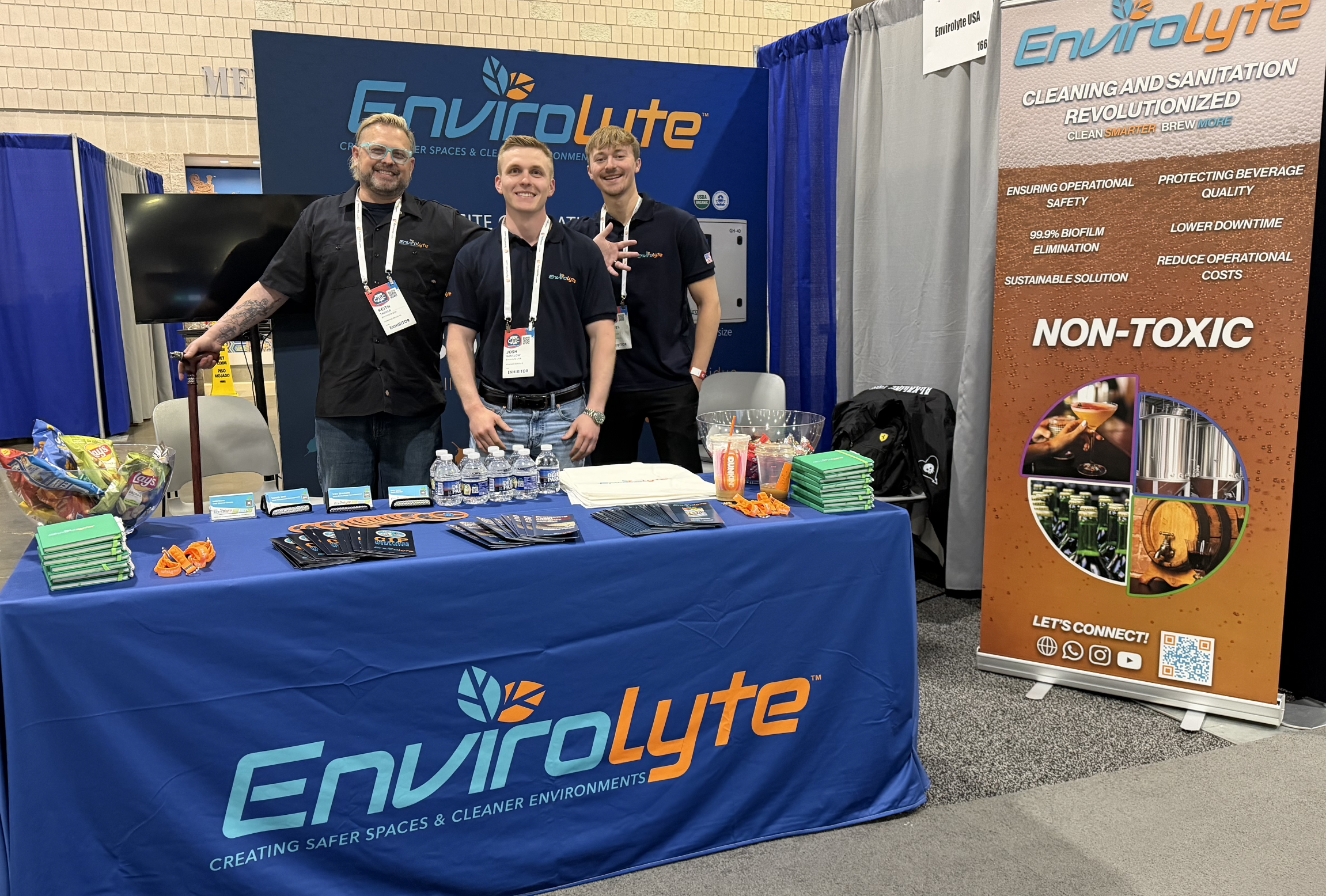
The current model depends on continuous chemical supply, repeated handling, and processes designed to add and then remove chemistry from the system. Envirolyte USA replaces that structure by producing sanitation chemistry inside the facility using water, salt, and electricity, with one solution for cleaning and one for disinfection.
When implemented correctly, entire layers of the current system are removed:
- Chemical deliveries and fuel-linked logistics costs.
- Storage rooms and multi-product inventory.
- Mixing and dilution across multiple chemistries.
- Repeated handling of concentrated chemicals.
- Rinse steps driven by chemical residues.
The result is a controlled internal process with stable inputs and predictable output. Wastewater variability decreases, chemical exposure is reduced, and water and energy demand drop because the process is no longer built around removing what was just added. Sustainability becomes the operational result of using less water, less energy, less chemistry, and less external supply.
What This Means Now
CIP is where cost, compliance, and production pressure converge, showing up every time a tank sits waiting, water continues to run past the endpoint, and discharge becomes harder to control. Over hundreds of cycles per year, extended rinses, repeated heating, and chemical handling accumulate into one of the largest recurring costs in the operation while increasing exposure at the drain.
For breweries still depending on extended rinse cycles, multiple chemical products, and constant deliveries, that cost is already embedded in the process and increasing with scale. The shift comes from removing the parts of the process that no longer need to exist and replacing the model that created them.
Start with one system. Measure water per cycle, total cycle time, and every input being handled, stored, and discharged. Compare that to a model where sanitation chemistry is produced on site and the process is reduced to what is actually required.
Envirolyte USA replaces the current sanitation program driving cost, variability, and handling in your operation. A controlled evaluation can validate cleaning performance, measure water and time reduction, and track what disappears from the process.
At that point, the decision is whether to keep paying for how CIP is built today, or to move to a system that removes that cost by design.
Your CIP program is already showing you where the cost is.
Every extended rinse, heating step, chemical delivery, and adjustment at the drain is part of the same structure. Measure one system and see what changes when sanitation chemistry is produced on site instead of purchased, stored, mixed, and removed.
