
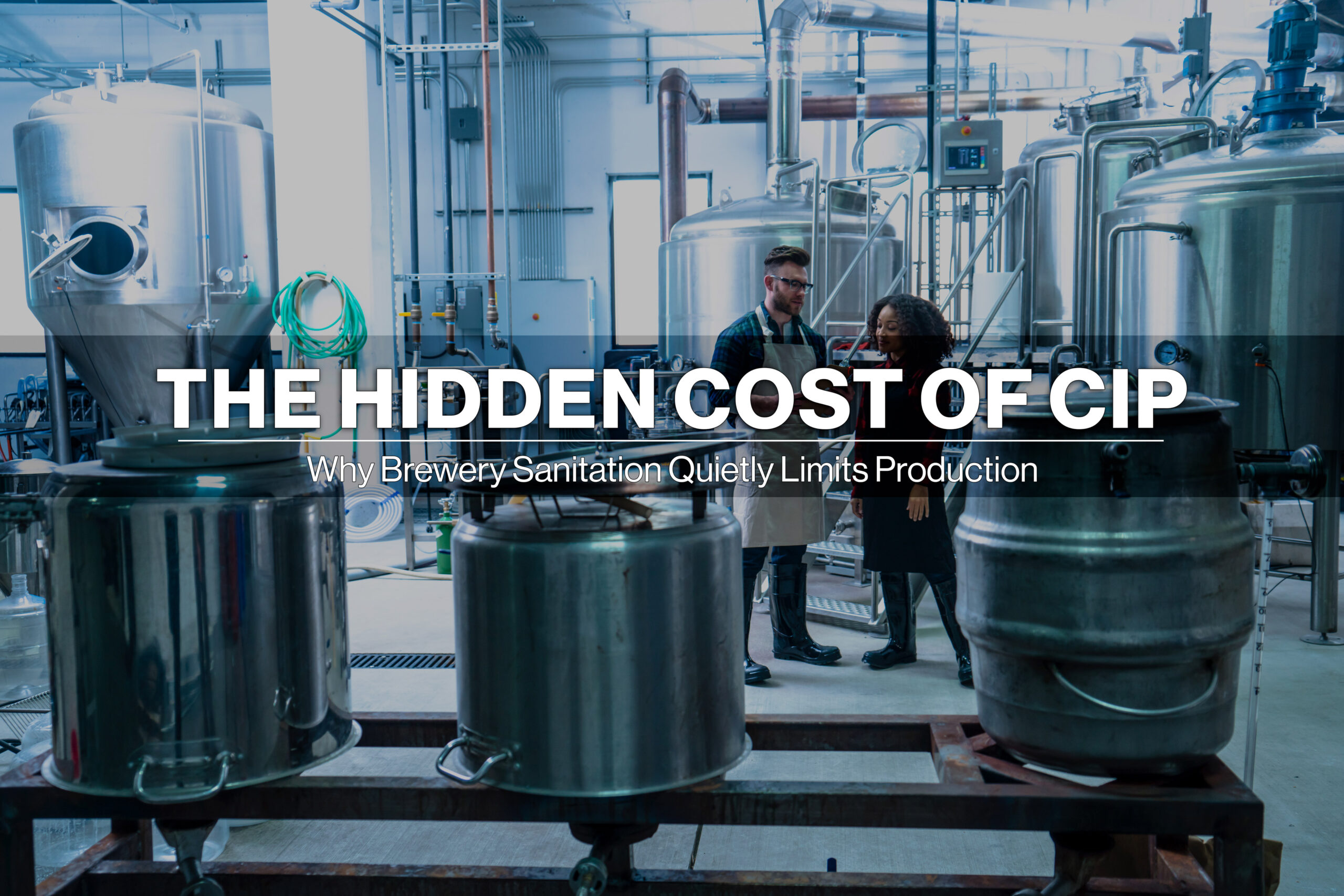
Brewery Sanitation Inefficiencies and the Structural Limits of Modern CIP Optimization
If sanitation defines your beer’s quality, why is it still treated as a cleaning task instead of a control system?
Brewery Sanitation Is Quietly Controlling Your Capacity
If you have ever walked into the cellar expecting a tank to be ready and found it still in rinse, you already know how much sanitation shapes production. Pumps circulate heated solution, steam hangs over stainless, and the schedule tightens before the first brew even starts. That delay rarely shows up on a report, yet it quietly limits how many turns your tanks can support each week.
Most breweries track barrels and revenue with precision, but far fewer measure how much usable capacity is absorbed by cleaning cycles that have gradually stretched beyond their original design. Rinse phases extend to prevent carryover, contact times are padded after a questionable swab, and concentrations rise to restore confidence. Each choice feels reasonable. Over time, they demand more water, more heat, and more handling while shrinking your production window.
When a batch referments or a tank fails a microbial check, the focus is the event. The deeper issue is whether your cleaning model maintains stability between brews or simply resets the system after problems appear. If control depends on periodic intensity rather than steady conditions, added time becomes the cost of reassurance. The brewery keeps running, but flexibility narrows and cost compounds.
The Real Cost of the Conventional CIP Model
Every brewer knows the sequence: pre rinse, caustic, rinse, acid, rinse, sanitize. It works. The real question is what it consumes.
Heated caustic must circulate long enough to strip soils, then be rinsed completely before the next phase begins. Acid introduces its own dwell time and another full rinse. Sanitizer follows under defined conditions, and water separates incompatible chemistries to protect product integrity. Across multiple tanks and multiple turns, that repetition makes cleaning one of the largest users of water, heat, and labor in the building.
Flow is never perfectly uniform across every valve and fitting, gaskets age, and certain surfaces become harder to clean consistently. When variability appears, concentration increases, contact time extends, and temperature rises. Confidence returns, but each adjustment adds minutes, heat load, and utility demand to every future cycle.
Ten extra minutes on a cycle does not feel dramatic. Repeated across several tanks each week, it becomes hours. Over a month, it can equal a full lost production day where stainless is occupied instead of producing sellable beer. That loss surfaces as overtime, compressed packaging runs, delayed shipments, or discussions about adding capacity. The issue is no longer whether CIP cleans. It is how much production time it quietly consumes.

Biofilm and the Escalation Pattern
Removing visible soil does not eliminate microbial risk. Biofilms can anchor to stainless and elastomer surfaces and persist beneath routine sanitation. Once established, they require stronger exposure or longer dwell times, increasing cycle intensity even when equipment looks clean.
The result is not a visible failure but a gradual escalation. Production resumes, yet the brewery runs hotter and longer than originally intended, and the system quietly consumes more time and utilities than it once did.
No brewery manages fermentation temperature by allowing drift and then overcorrecting with excess heat, and no quality team accepts water chemistry that swings between extremes. Both are held within defined limits because stability protects yield and consistency. Sanitation deserves the same discipline rather than reactive reinforcement.
A Different Way To Think About CIP
Modern CIP optimization begins with a shift in operating model. Instead of purchasing, storing, and managing multiple chemicals that are deployed in escalating sequences, the brewery produces two solutions on site: a cleaner and a disinfectant generated from salt, water, and electricity.
This change is not about adding another piece of hardware to the floor. It replaces the chemical program itself. When solutions are produced at the point of use, concentration is controlled at the source and no longer dependent on storage time, delivery schedules, or manual dilution. Bulk chemical deliveries decline. Storage space contracts. Mixing steps are removed. The number of products operators must handle is reduced.
Because the chemistry is generated and controlled internally, cleaning protocols can be simplified. Fewer transitions between incompatible products reduce the need for repeated buffering rinses. Lower reliance on high heat and escalating concentrations reduces utility demand. Handling exposure decreases because operators are not routinely managing multiple concentrated chemicals in wet environments.
The impact shows up first in daily operations, where the difference is not theoretical but visible in shorter cycles, fewer interruptions, and a floor that runs with less friction and more control.

Where Envirolyte Strengthens the Model
Implementing this level of control requires more than switching chemicals. It requires sanitation infrastructure inside the brewery that continuously produces the solutions cleaning depends on. Envirolyte implements that infrastructure as part of the facility’s sanitation program, replacing the traditional chemical supply model with two solutions generated on site: an alkaline cleaner and a disinfectant.
Instead of purchasing drums of chemicals, storing them, diluting them, and managing deliveries, the brewery produces those solutions internally using salt, water, and electricity. The equipment operates as part of the sanitation infrastructure, supplying fresh chemistry whenever CIP or sanitation routines require it.
This means the brewery is no longer managing a rotating inventory of purchased chemicals. The cleaner and disinfectant are produced at the moment they are needed, with concentration controlled by the system rather than by storage conditions or manual dilution.


What Changes In Daily Operations
Instead of building your production plan around chemical deliveries and inventory checks, the brewery produces exactly what it needs, at the moment it needs it. Instead of dedicating floor space to multiple drums, secondary containment, and backup stock, teams manage two solutions generated inside the facility. Instead of padding cycles because concentration may have degraded or dilution may vary by shift, sanitation conditions are controlled at the source and remain consistent from run to run.
What changes is not subtle. A recurring operational burden disappears as deliveries decline, storage shrinks, and mixing steps fall away. Under validated protocols unnecessary buffer rinses can be reduced, routine handling of concentrated chemicals decreases, and inventory management stops dictating part of your week. What once required ordering, storing, transporting, checking, and preparing becomes a controlled internal function.
When sanitation chemistry is produced and controlled inside the facility instead of arriving through external chemical deliveries, tank turnaround stabilizes and confidence no longer depends on adding time or heat. Water and energy use become measurable. Labor shifts back toward production. The pressure that once felt normal begins to lift. If control, capacity, and cost can be stabilized this way, why continue operating under a model that requires constant escalation?
Why This Matters Now
If you are responsible for keeping tanks turning and customers supplied, sanitation touches your margin and your stress level every week. Energy prices fluctuate, water use is scrutinized, audits are tighter, and supply chains are less predictable. In that environment, longer and hotter cleaning cycles are not neutral choices.
Every additional rinse is water you must justify. Every extended heating phase is cost you absorb. Every chemical delivery is dependency. None of these are dramatic alone, yet together they shape how confidently you can plan production and grow without adding pressure to your team.
Sanitation can remain a routine that quietly tightens your schedule, or it can become a controlled operating function that protects capacity and margin. CIP optimization is not about tweaking chemistry. It is about deciding how much growth you are willing to sacrifice to repetition.
Every minute your rinse cycle runs longer than it needs to, it is not just cleaning your tank. It is erasing margin and capacity you already built.
References
- Hypochlorous Acid: A Review A comprehensive scientific review of hypochlorous acid’s antimicrobial properties and biofilm disruption mechanisms, useful for understanding HOCl efficacy from a research perspective.
https://pmc.ncbi.nlm.nih.gov/articles/PMC7315945/
- A Review of Factors Affecting Clean-in-Place (CIP) Efficiency An academic review covering the efficiency challenges of CIP systems in closed processing environments, including fouling and energy implications.
https://www.sciencedirect.com/science/article/abs/pii/S036054421930756X
- Microbial Biofilms in the Food Industry — A Comprehensive Review A detailed review of biofilm formation and resistance in food processing settings, demonstrating why traditional sanitizers struggle to control biofilms.
https://pmc.ncbi.nlm.nih.gov/articles/PMC7922197/
- Process Hygiene Control in Beer Production and Dispensing A credible industry publication focused specifically on process hygiene and microbial control in beer production environments.
https://publications.vtt.fi/pdf/publications/2000/P410.pdf
- Hypochlorous Acid (General Reference) A concise overview of hypochlorous acid chemistry, disinfectant action, and applications, suitable for high-level contextual understanding of HOCl as a sanitizer.
https://en.wikipedia.org/wiki/Hypochlorous_acid
Learn More About Brewery Sanitation Control
If you are evaluating how to stabilize tank turnaround while reducing water, heat load, and chemical handling, our team can share technical information on on-site solution generation and implementation considerations for brewery CIP and sanitation programs.
