
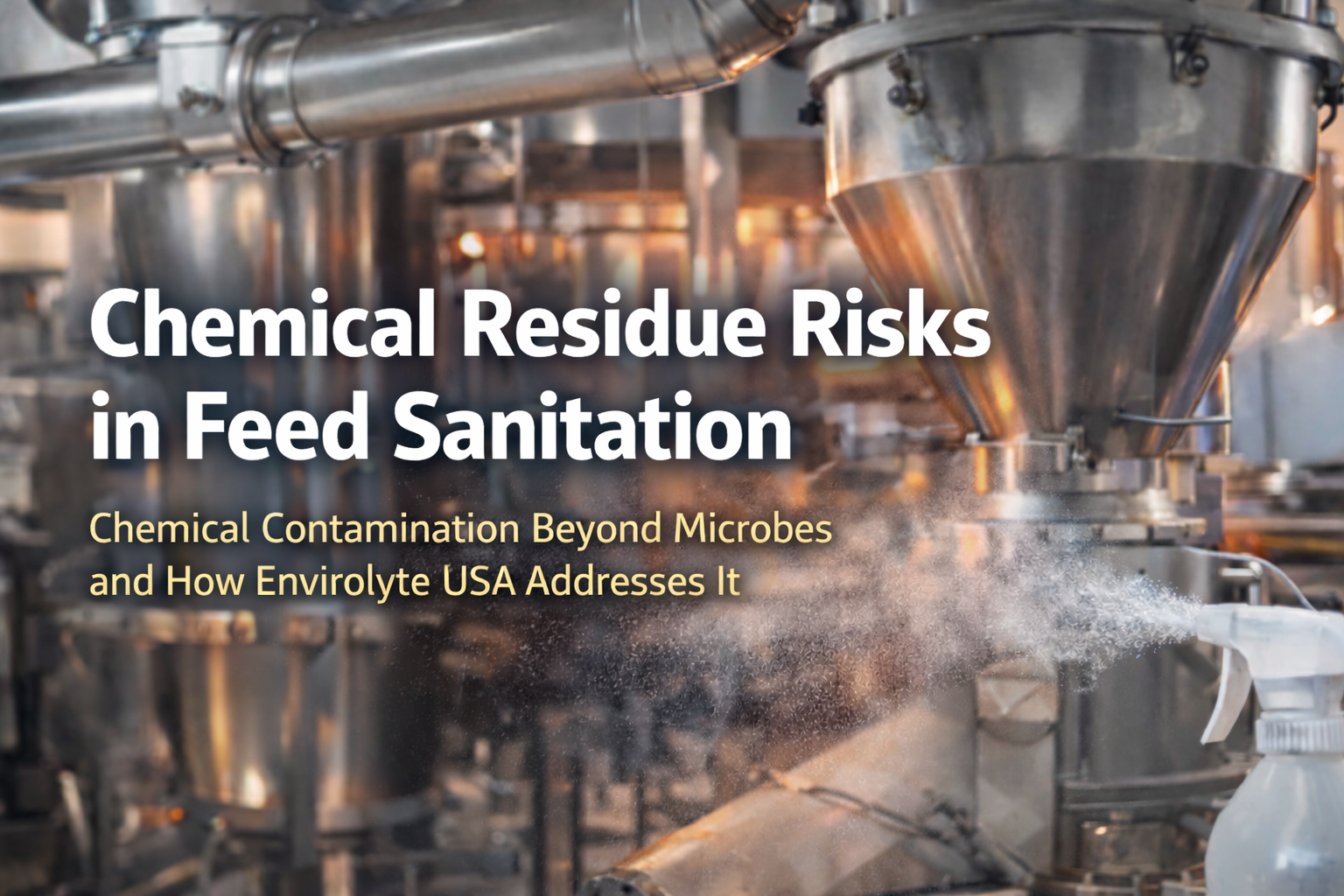
Residue and Feed Safety Risks: Chemical Contamination Beyond Microbes and How Envirolyte USA Addresses It
In feed mills and animal food ingredient facilities, sanitation is typically framed around microbial control, Salmonella, Listeria, molds, and other pathogens that threaten feed safety. However, there is a parallel issue that is chemical, not biological: residual sanitizers left on feed contact surfaces that can contribute to feed tainting, regulatory challenges, and safety concerns if not properly managed.
This post explores why conventional disinfectants can create residue risks, how that impacts feed safety and regulatory compliance, and how Envirolyte USA’s neutral pH hypochlorous acid (HOCl) solutions provide effective sanitation without hazardous residues.
The Problem: Chemical Residues on Feed Contact Surfaces
Chemical residues on food related surfaces pose multiple risks:
- Residual sanitizers on contact surfaces can transfer into feed, leading to taste, odor, or chemical contamination issues.
- There is a potential for feed tainting, which can affect quality and even animal health outcomes.
- Regulatory authorities scrutinize unexpected residues, especially in facilities subject to hazard analysis and critical control point (HACCP) audits and international standards.
- Residue concerns are a recognized aspect of sanitation protocols in food and feed processing, where regulators and sanitation engineers emphasize surface chemistry and microbial hygiene in tandem.
Why Current Systems Create Residue Risk
Quaternary Ammonium Compounds and Phenolics
Sanitizers based on quaternary ammonium compounds (QACs) and phenolic chemistries are widely used because of their relatively broad antimicrobial spectrum and surface activity. However:
- These compounds can leave persistent films or residues when applied at higher concentrations. That residual film, while reducing microbes, can remain on stainless steel, plastics, and elastomeric surfaces if not completely rinsed.
- According to recent EPA review work, QACs are expected to leave the most residue on hard surfaces after application among common disinfectants, requiring careful rinsing to avoid residue transfer, a significant consideration for feed contact equipment.
Rinse Water Requirements and Inconsistency
Rinsing to remove sanitizer residues introduces its own challenges:
- Effective rinsing is water intensive and operationally expensive in feed environments with high throughput.
- Rinsing effectiveness varies with operator technique, water pressure, surface geometry, and the type of sanitizer used.
- Without standardized measurement of residual levels post rinse, some systems may leave sub ppm remnants that still present process risk.
Operator Overdilution and Safety Margins
Operators under pressure to ensure microbial kill often overdose sanitizers to be safe. While understandable, this increases the burden of rinsing and raises the likelihood of residual chemicals on food contact surfaces. Paradoxically, excessive sanitizer concentrations can lead to both microbial risk mitigation and chemical safety concerns.
The Feed Safety and Regulatory Context
Regulations governing sanitation in food and feed facilities require that:
- All food contact surfaces be maintained in a condition that does not adulterate the product.
- Sanitizer residues must be managed such that they do not exceed levels considered safe for animal feed or food processing contexts.
- Government publications on cleaning and sanitizing in food handling environments specifically list both antimicrobial efficacy and surface residue safety as dual pillars of an effective sanitation program.
How Envirolyte USA Solves the Residue Problem
Hypochlorous Acid (HOCl) That Leaves No Residual Chemical Film
Envirolyte USA’s systems generate electro activated hypochlorous acid solutions on site that:
- Are effective antimicrobial agents at low concentrations.
- Break down naturally after use into benign saline, water and trace ionic salt.
- Do not leave persistent quaternary or phenolic residues requiring extensive rinsing.
Because Envirolyte USA solutions do not introduce long lasting chemical films or surfactants on feed contact surfaces, the risk of feed tainting is significantly reduced.
Simplified Validation and Documentation
Residue safety is a major concern during audits and HACCP verification activities. With Envirolyte USA solutions:
- Compliance documentation is simplified because sanitation results rely on measurable microbial reduction rather than unquantified residual chemicals.
- Eliminating rinsing dependent residue uncertainty also simplifies validation cycles for QA teams.
Lower Regulatory and Recall Risk
By avoiding persistent chemicals on feed contact surfaces, facilities can:
- Reduce the likelihood of detecting residual sanitizers during third party sampling.
- Lower the risk of feed quality issues flagged by supply chain partners or regulators.
- Improve confidence that microbial sanitation has not inadvertently introduced chemical contaminants.
Feed quality, regulatory compliance, and operational confidence.
While microbial safety rightly remains a cornerstone of feed facility sanitation, the chemical dimension of residue risk is equally critical for protecting feed quality, regulatory compliance, and operational confidence.
Conventional sanitizers like quats and phenolics, and even some chlorine based oxidizers, can leave surface residues that are difficult to measure, hard to rinse consistently, and potentially problematic for feed products. Scientific and regulatory literature acknowledges this dual challenge of efficacy and residue management in sanitation programs.
Envirolyte USA’s HOCl based sanitation approach provides a modern, low residue alternative that meets both microbial and chemical safety needs. By eliminating persistent chemical films and simplifying rinse requirements, facilities gain a cleaner feed contact environment and improved regulatory confidence.
References & Further Reading
- Basic Elements of Equipment Cleaning and Sanitizing in Food Processing and Handling Operations EDIS / IFAS (University of Florida). https://edis.ifas.ufl.edu/publication/FS077
- Sanitizers for Food Plants Oregon State University. https://seafood.oregonstate.edu/sites/agscid7/files/snic/sanitizers-for-food-plants.pdf
- EPA Releases Finalized Test Methods for Measuring Disinfectant Residue Levels on Hard Surfaces EPA. https://www.epa.gov/pesticides/epa-releases-finalized-test-methods-measuring-disinfectant-residue-levels-hard-surfaces
- Emerging and Innovative Technologies for the Sanitization of Fresh Produce: Mechanisms and Applications Foods / MDPI. https://www.mdpi.com/2304-8158/14/11/1924
- Yuqiao Jin, Achyut Adhikari Foods2025, 14(11), 1924; https://doi.org/10.3390/foods14111924
Learn More About Low Residue Sanitation in Feed Operations
If you are evaluating sanitation strategies that reduce residue risk while maintaining hygiene objectives, our team can help you assess how electro activated solutions fit within your operating conditions and verification requirements.
